
Hikers, Campers, Families, and Pet Owners Can Protect Themselves in the Mountains
The Appalachian Mountains are among the most beautiful and well-known outdoor destinations in North America. Millions of people head into the mountains every year looking for waterfalls, scenic overlooks, trout streams, solitude, and cooler air. And especially hiking.
It’s the home of the most famous hiking trail in the United States, the Appalachian Trail. The AT runs from the forests of New England to the ridges and hollers of Georgia. For hikers, it’s the holy grail of trails.
Hiking in Appalachia is a safe activity. It’s so safe, in fact, that few hikers contemplate the dangers of the woods. If the idea crosses their minds at all, most visitors think about bears (rare), snakes (not as rare), or getting lost (fairly common).
Statistically, however, the most dangerous creatures in the Appalachian woods, and the ones hikers are likely to encounter, are not even on most hikers’ radar. They are too small even to be a blip on radar.
Ticks.
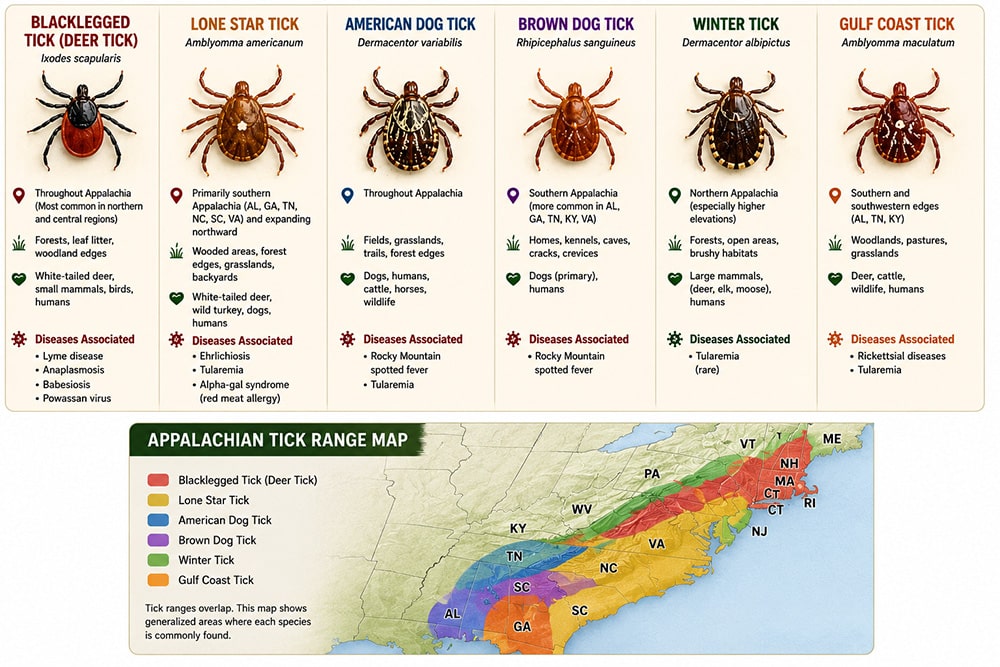
Ticks are by far the most common and most medically significant outdoor hazards in Appalachia. They are found throughout the mountain chain, from Alabama to Maine. As of this writing in summer 2026, they are everywhere. It is the worst tick season in years.
Many tick species carry diseases that can cause long-term illness or even permanent disabilities. The most well-known is Lyme disease, carried by the deer tick. A hot topic on social media and in the news in 2026, Alpha-Gal Syndrome is a potentially life-changing allergy to red meat caused by a toxin transmitted by the Lone Star tick.
Many visitors underestimate how easily ticks attach to humans, children, and pets. Ticks are good at it. It’s what they do for a living.
Fortunately, hiking safely in tick territory is not complicated. Most bites can be prevented through proper clothing, careful trail behavior, smart campsite management, and consistent post-hike checks.
Preparation is key
The Appalachian outdoors rewards preparation.
Millions of people safely explore Appalachia every year. The key difference between experienced hikers and careless visitors is rarely toughness or endurance. It is preparation.
The Appalachian Mountains demand attention to detail. Before going out in the woods, camping, or on a trail, the smart outdoors person makes note of
- weather
- water
- terrain
- navigation
- wildlife
- ticks
Those who pay attention and plan ahead usually enjoy the mountains the most. Those who don’t might go home with unpleasant memories.
The Appalachian woods are not out to get anyone. But they also do not care when someone arrives unprepared.
Understanding Where Ticks Thrive
Ticks are like tourists. They are drawn to exactly the kinds of places hikers and campers enjoy most.
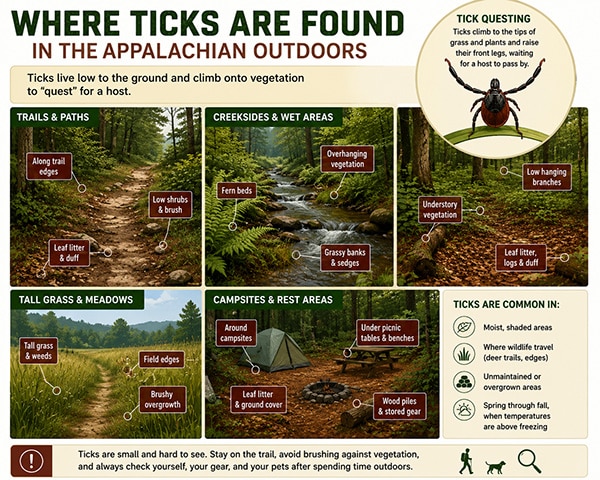
Appalachian terrain provides nearly ideal conditions for several tick species. Ticks thrive in the humid hardwood forests that climb the mountainsides. They also love transitional areas, like fern-covered creek bottoms, tall grass that borders roadways and open fields, and the brushy edges of woods near campsites.
How Ticks Get on You
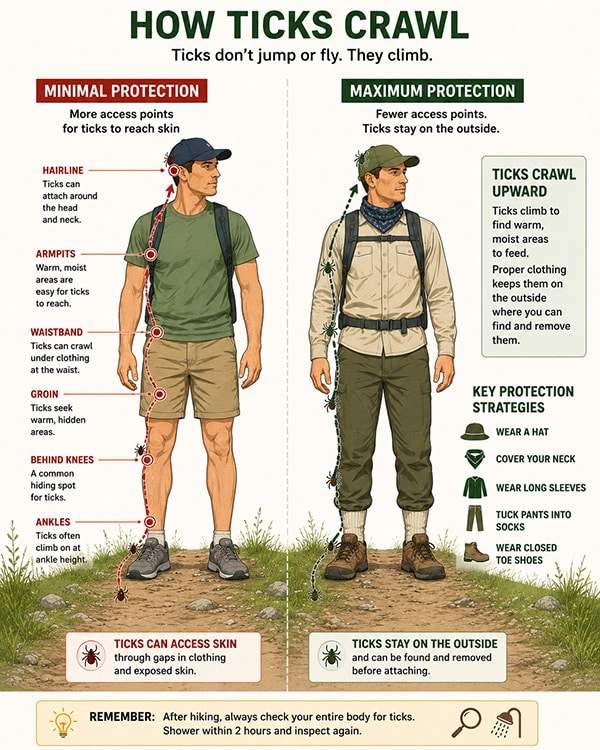
Ticks do not jump. They do not fly. Most do not drop from trees.
Instead, they wait in ambush.
Contrary to popular belief, ticks do not usually fall from trees. Most species climb low vegetation–grass blades, weeds, low branches, and brush along trails–and wait with front legs extended and waving in the air. This behavior is called “questing.” When a person or animal brushes against vegetation, the tick grabs on and begins searching for exposed skin. New research suggests that ticks are also propelled by static electricity generated as creatures move through the landscape. They ride an invisible electric charge to catch hold of passing animals and people.m
If they can get to them, ticks’ favorite spots to attach are:
- Ankles
- Behind knees
- Waistbands
- Groin area
- Armpits
- Hairline
- Behind ears
How to Dress for Tick Country
Proper clothing remains one of the best defenses against ticks.
Too many hikers dress only for comfort or temperature. Big mistake! When hiking in tick territory, especially in areas crawling with ticks (literally), protection matters just as much as staying cool. There is a recognized strategy for dressing to mitigate the risk of tick bites.
Let’s start at the bottom and move upward…
Biggest point: tuck your pants into your socks. Yeah, it may look a little dorky, but serious hikers and outdoors people will understand. As they say, if you know, you know. And they know.
Ticks often attach low on the body before crawling upward. Good crew or knee-high hiking socks are a must. They create a physical barrier while helping prevent blisters on steep Appalachian terrain.
Wear light colors. While it is true that ticks are drawn to lighter colors, there is a good reason to avoid dark-colored clothing. All tick species are dark in color. When they scurry across light-colored fabric (khaki, tan, or gray), they are easily spotted.
Tick-repelling clothing. There are clothing products on the market today that are reportedly “tick-repellent or “anti-tick.” The brand Insect Shield that offers clothing infused with Permethrin, which we discuss below. It’s expensive stuff, but it comes pre-loaded with repellent. Since you can achieve the same effect yourself with a liquid or aerosol Permethrin, you might want to DIY it.
Don’t wear wool or cotton. Lightweight synthetic hiking clothing works best because it dries quickly while providing better coverage than shorts and tank tops. Cotton is a sponge. In the summer, it will fill with sweat in no time. For that reason, in cooler months, it makes a horrible base layer under other fabrics. Wool is hot in the summer, and slow to dry out, but surprisingly versatile in the Autumn or late Spring.
Check out our blog “What you need to hike in the Appalachian Mountains” for detailed clothing suggestions.
Socks and Footwear
Socks. The first line of defense.
Hiking socks can be expensive, but they are a big improvement over the basic athletic socks offered by department stores. A great choice is merino wool socks.
Shoes. Trail runners are popular throughout Appalachia, but in dense undergrowth, many hikers still prefer lightweight hiking boots that provide ankle coverage.
Pants Matter More Than Most People Realize
Long pants are strongly recommended in tick-heavy areas. Shorts are cooler, yes, but they leave the lower legs exposed to vegetation where ticks commonly wait. Those bare legs are a vertical highway for ticks moving north to warm, sheltered wastebands, groins, and hair.
Convertible hiking pants are useful because the lower sections can be removed in lower-risk environments and as the day heats up.
Shirts and Base Layers
Long-sleeve synthetic hiking shirts provide another layer of defense without trapping as much heat and moisture as cotton shirts do. Moisture-wicking materials are preferable because Appalachian humidity can become oppressive in summer.
The cuff should fit tightly around the wrist, and the neck should not be loose. Many people wear a bandana around the neck to keep ticks out.
Recommended Features
- UPF sun protection
- Quick-drying fabric
- Ventilation panels
- Synthetic or merino blends
Recommended Products
- Insect Shield Men's Field Shirt Pro - This button-up shirt is treated with permethrin. It’s dressier than the typical outdoors shirt, so it can do double duty while in the mountains. It’s around $70.
- Mossy Oak Insect Repellent Fishing Tee - Despite its name, it’s not just for fishing. For about $20, you get a durable shirt treated with insect repellent that lasts for 90 washes.
Tick Repellents That Actually Work
Repellents are one area where marketing hype often overwhelms practical reality.
Some products genuinely help. Others do very little.
The three most commonly recommended active ingredients are:
- DEET
- Picaridin
- Permethrin
DEET
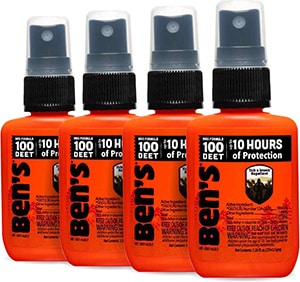
DEET (diethyltoluamide ) is the GOAT of the repellent world. Developed in 1944 for the US military, DEET was released to the public in 1957. In 1991, the EPA approved a newer formulation that slowed evaporation and lengthened the effective time of an application. DEET is one of the most effective skin-applied repellents.
DEET works well against ticks, mosquitoes, and biting flies. In rare instances, users report rashes due to an allergy to the product.
For hiking in Appalachia, concentrations between 20% and 30% are generally sufficient.
Recommended Products
- OFF! Deep Woods
- Repel Sportsman Max Formula (40% DEET)
- Ben’s 30 Tick & Insect Repellent (get the 10-hour version…it’s the same price as the 7-hour)
- Sawyer Maxi-DEET Spray
Picaridin
Many hikers and campers prefer picaridin because it is odorless, less greasy, and less likely to damage synthetic fabrics or plastics. Effectiveness against ticks is generally considered very good. It also repels other biting insects, including mosquitoes.
Recommended Products

Permethrin
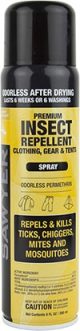
Permethrin is not for use on skin. It is applied to clothing. It is the go-to product for most outdoorspeople in the Appalachian Mountains. This treatment is highly effective against ticks. Ticks that crawl across treated fabric often die before attaching.
Many experienced Appalachian backpackers consider permethrin-treated clothing one of the best available defenses. Spray it on and allow it to dry before putting on clothing. Depending on the product, Permethrin can last from 4 to 6 weeks on fabrics, especially backpacks, shoes, and tents. If you wash sprayed clothing, it will last through an average of six washings.
We do not recommend spraying hats with Permethrin. On a hot day, hats become sweaty and the sweat can carry the chemical down into eyes and mouths. Not a good thing.
Important!
Never apply wet permethrin directly to skin or near cats. It is highly toxic to felines.
Recommended Products
- Sawyer Permethrin Clothing Treatment (the brand we use here at Appalachian Experience)
- Insect Shield Premium Permethrin Spray
All-Natural repellents
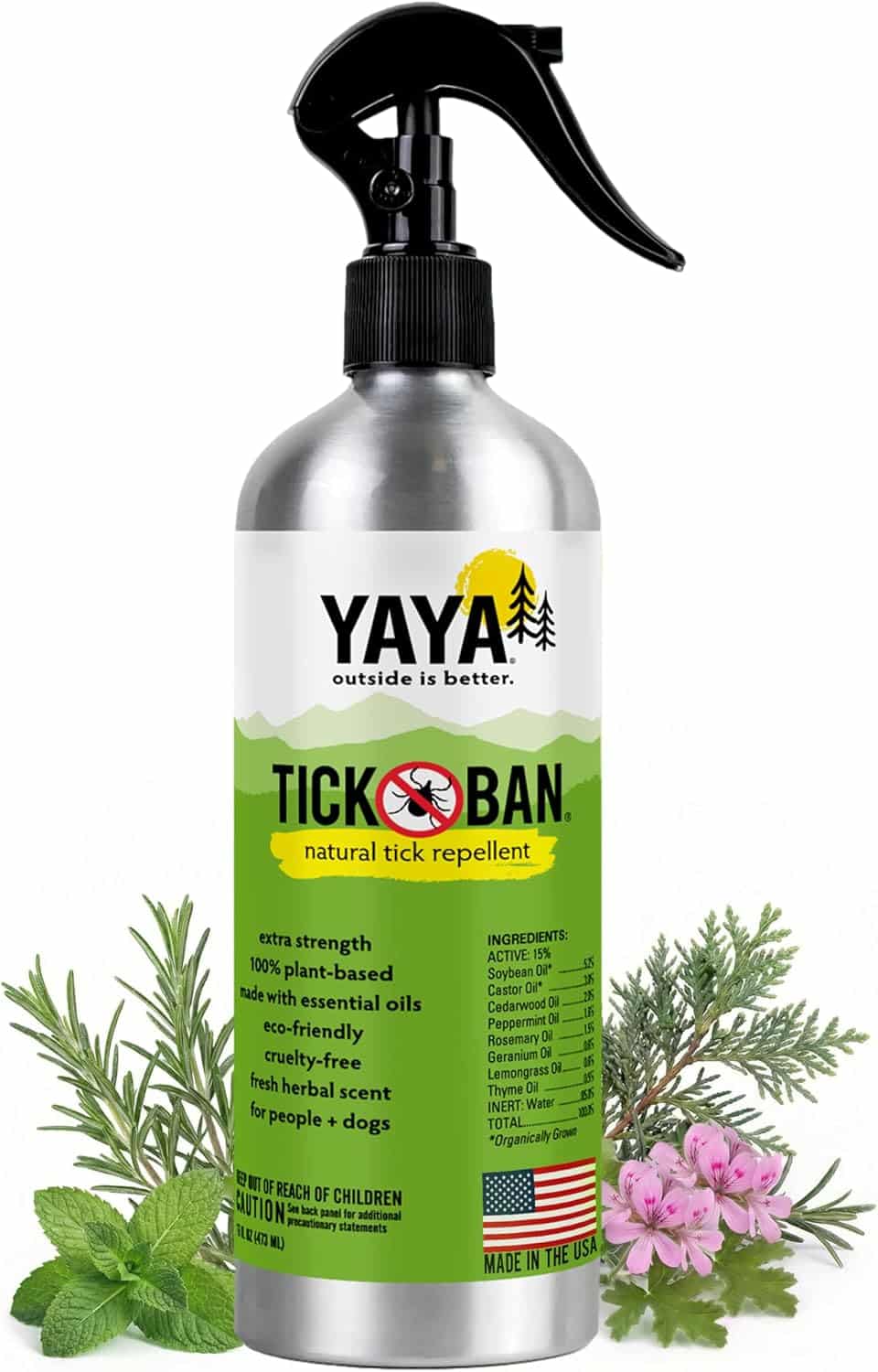
There are a number of all-natural repellents on the market. They meet with mixed reviews and are generally considered not as effective as DEET and Picaradin. Yaya Organics gets good reviews on Amazon and is made from a combination of plant oil extracts. This product does not smell bad (it actually smells nice!) and it doesn’t leave your skin or clothing feeling all chemicall-y.
Recommended Product
Looking for reliable, trail-tested gear? Visit our Appalachian Experience Amazon Storefront to explore our favorite hiking, camping, travel, and outdoor products. Disclosure: As an Amazon Associate, Appalachian Experience earns from qualifying purchases.
Trail Behavior That Reduces Tick Exposure
What hikers do on the trail matters just as much as what they wear. In order to hike safely in tick territory and avoid them, you have to think like a tick.
Ticks climb to the top of grasses, ferns, and bushes in the hope of an animal coming along and brushing into their hiding place. They tend to cluster where vegetation has the best chance of touching passing critters and people. So, stay away from the edges of paths where low vegetation is found. Keep to the center of the trail as much as possible.
Parents with smaller children must keep the kids out of the woods and undergrowth! Better still, teach them about the danger of ticks and the basics of how to avoid them. Show them photos and videos of ticks so they know what to look for. When you encounter a tick (and you will eventually), make sure you show the kids so they have first-hand experience with identifying them.
Groups, families, and couples should regularly check each other for signs of ticks on clothing or skin.
Many Appalachian outdoors people pick up ticks while:
- Sitting on logs
- Taking breaks in tall grass
- Gathering firewood
- Setting tents near brush
- Fishing stream banks
- Walking dogs through overgrowth
The Appalachian woods feature notoriously dense undergrowth. It’s prime real estate for ticks. Bushwhacking through thick undergrowth dramatically increases exposure.
Best practices in the outdoors includes:
- Avoid brushing vegetation unnecessarily
- Perform quick leg checks during breaks
- Keep packs off dense ground cover
- Choose open campsites with airflow and sunlight
Simple habits help significantly.
Solo Hikers Face Different Risks
Single hikers can efficiently navigate through the woods. They often move faster and farther than families or groups, but they are at a disadvantage in recognizing tick warning signs.
It is difficult for a single person to see all the places ticks like to hide on a body. A lone hiker may not notice ticks attached to the back of the neck, behind the knees, in the groin, near the hairline, or in the hair.
Hikers should:
- Carry tweezers in first aid kits
- Perform full-body checks before sleeping
- Inform someone of route plans
- Avoid camping directly beside game trails
Because solo hikers sometimes push deeper into isolated terrain, prevention becomes even more important.
Camping Safely in Tick Country
Backcountry camping sites along the many hiking trails in Appalachia are obvious tick hotspots. But even campgrounds can be just as bad if they are heavily wooded or poorly maintained.
Tent placement matters. It’s best to find an open, breezy area with shorter vegetation. Damp areas or those with lots of longer ground cover should be avoided.
Avoid:
- Thick leaf litter
- Tall grass
- Dense understory
- Areas heavily traveled by deer
Many campers unknowingly carry ticks into tents on:
- Pants
- Blankets
- Dogs
- Firewood bundles
- Camp chairs
Best practice is to create a “clean zone” around sleeping gear where shoes, dirty clothing, and packs remain separated from sleeping bags and pillows.
Protecting Children on Appalachian Trails
Children are especially vulnerable to tick bites. They play close to the ground and tend to wander into brush. Kids also just sit down wherever they are, including in vegetation that could contain ticks.
Children also don’t know what to look for. It’s incumbent on parents to teach even the youngest kids about the danger of ticks and how to avoid them. Once educated, even small kids are good at spotting ticks and avoiding places that might harbor them.
Parents should perform regular tick checks during and after hikes. Common attachment areas on children include:
- Scalp
- Behind ears
- Waistbands
- Armpits
- Groin area
Follow the same clothing rules described above for kids. Light-colored clothing helps parents spot ticks more easily.
For younger children, permethrin-treated clothing can be especially helpful because
children often ignore trail discipline.
Dogs and Ticks in Appalachia
Dogs frequently pick up ticks before humans do. A dog moving through brush acts almost like a tick magnet. Ticks carried indoors by pets can later crawl off the pet and look for a human.
Dog ticks (wood ticks) are not the only species that latch onto dogs. Black-legged ticks (deer ticks) and Lone Star ticks also hop on dogs.
DO NOT spray DEET or Picaradin on pets! These products can be highly toxic to pets.
It is always a good idea to use veterinarian-approved tick preventatives, such as Seresto collars, K9 Advantix II, and Frontline Plus. Be sure to carry tick-removal tools and check dogs carefully after hikes.
Areas commonly missed include:
- Between toes
- Under collars
- Around ears
- Under tails
Dogs can also suffer serious tick-borne illnesses, including ehrlichiosis and Lyme disease.
Post-Hike Tick Checks
Finding a tick on your body does not guarantee disease. Even if a tick bites, it doesn’t mean the host is automatically infected. Many tick-borne diseases become less likely if ticks are removed quickly.
A proper post-hike check should happen as soon as possible after returning indoors. Showering within two hours may help remove unattached ticks.
Clothing should go directly into a hot dryer for at least 10 minutes before washing. Since ticks breathe only a few times per hour, washing alone may not kill them.
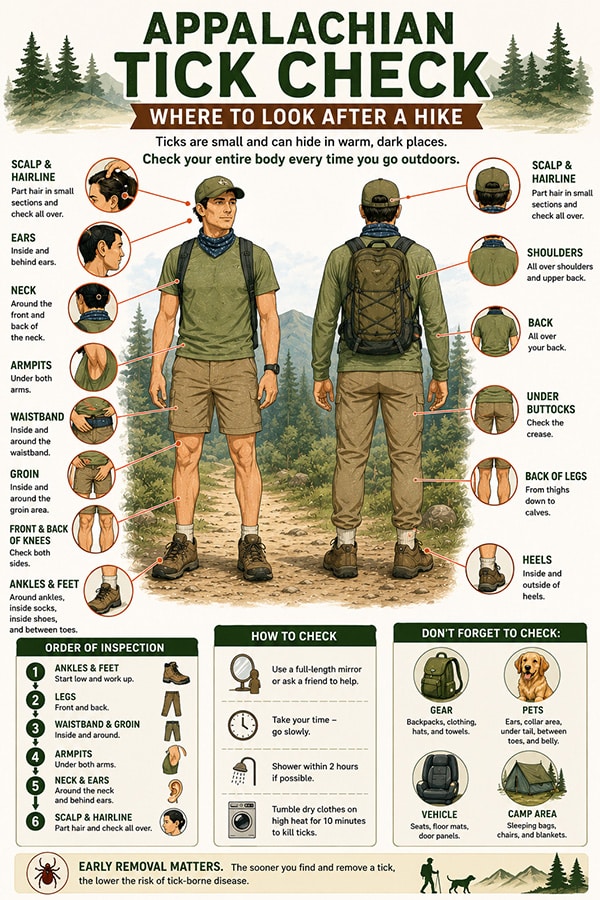
Remember, ticks generally climb up a body to find a warm piece of skin on which to hide. A careful body inspection should include:
- Ankles
- Behind knees
- Waistbands
- Hairline and hair
- Armpits
- Groin
- Behind ears
This is not paranoia. It is normal Appalachian hiking hygiene.
After an impromptu 40-minute hike on the Flat Creek Loop in the Aska Adventure Area near Blue Ridge, Georgia, in June 2026, we found two ticks on my legs, one on my wife's back, and five on our dog, James.
Poor James.
Silent and undetectable blood-suckers.
You might feel a tick as it crawls–surprisingly quickly–up your leg or arm. But, as with mosquitoes, tick saliva contains compounds that reduce pain and irritation, so many who are bitten don’t realize it. Unlike mosquitoes, ticks don't just bite and take off. They have mouth parts that scissor into the host’s skin before insertion of a barbed feeding tube. To make removal even more difficult, ticks often secrete a cement-like substance that super-glues them in place.
Once in place, the tick hangs on, feeding and expanding from a flat body measuring 0.3 cm into a bulbous, blood-filled oval that might be more than a centimeter wide.
What To Do If You Find a Tick on your body?
Ticks and spiders are related (both are in the arachnida family), so perhaps it isn’t surprising that both elicit the same reaction when spotted. For many people, it is instant panic. Maybe a shriek. Many go straight to Google to find out what to do next.
First, is the tick walking around, or has it attached?
If the tick hasn’t attached to the skin, it’s easy enough to pick it up (with your fingers or in a tissue) and dispose of it. Most captured ticks go the way of dead goldfish: down the toilet. That’s a safe way to get rid of it because ticks are notoriously difficult to kill otherwise.
If the tick is attached.
There is a lot of folk medicine associated with tick removal. Most of it is wrong. "Using matches or nail polish remover or Vaseline ─ you want to avoid those," says Dr. Bobbi Pritt, a Mayo Clinic parasitic diseases expert. The Mayo Clinic and the Centers for Disease Control both advocate the following process for removing a tick:
Proper Removal Steps
- Use fine-tipped tweezers
- Grasp close to the skin (do not grab the body; it will detach from the mouthparts)
- Pull steadily upward (twisting can break off mouthparts)
- Clean bite area
- Monitor symptoms
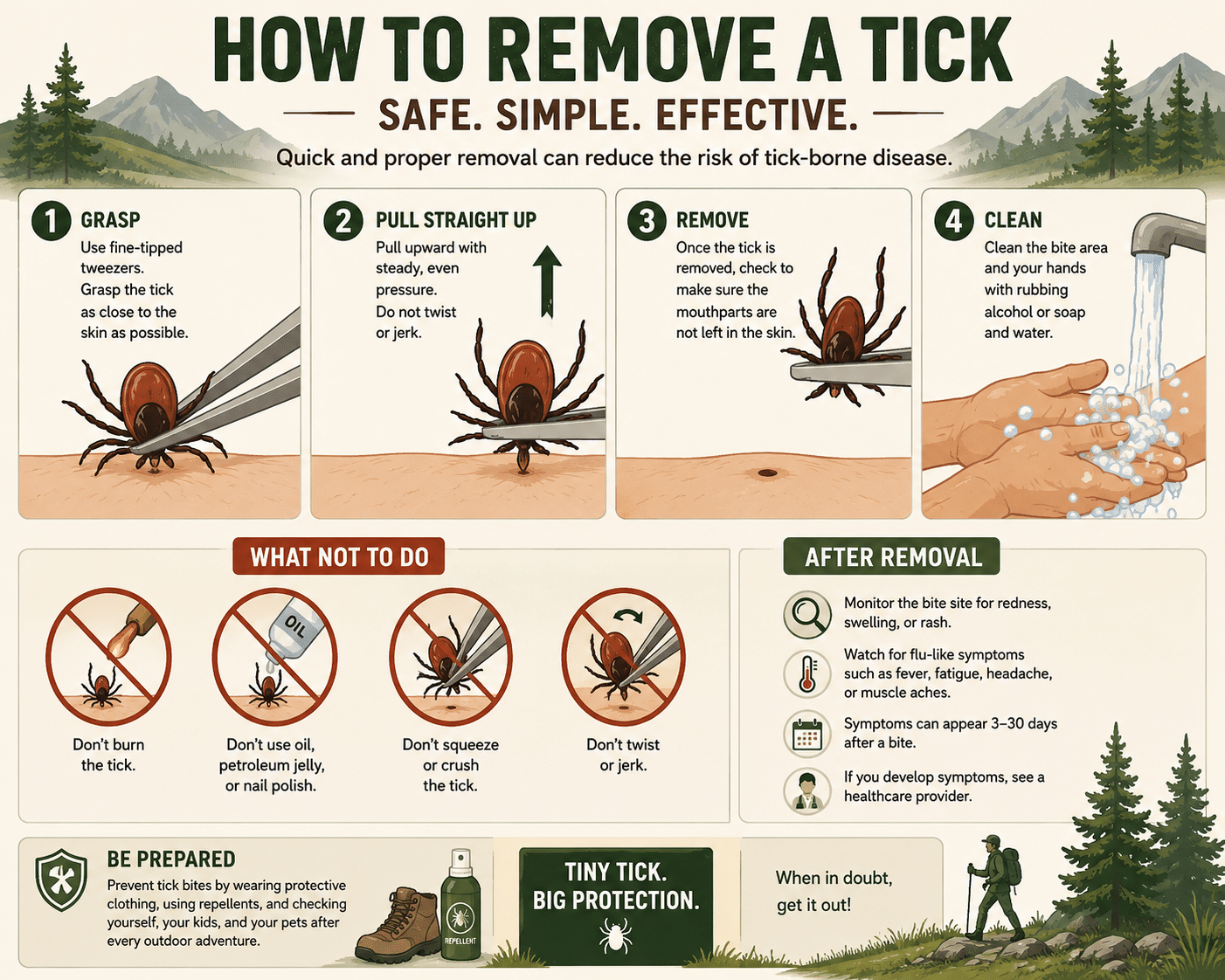
Do not:
- Burn the tick off - many a tick has been singed by cigarettes. Don’t do this. It doesn’t even seem to be a good idea!
- Cover it in petroleum jelly - ticks breathe only a few times per hour, so being covered up doesn’t necessarily break their stride. It might panic them, however, causing them to regurgitate contaminants into the open wound.
- Twist violently - this can break off the tick’s mouthparts, which can cause a localized infection,
Some people save ticks in sealed containers for later identification if symptoms develop.
Important note: even if a tick carries Lyme disease bacteria, transmission is not guaranteed. In many cases, a tick must remain attached for 24–36 hours before the risk of transmission rises significantly.
Tick Bite Statistics in Appalachia and the United States
Estimated Annual Numbers

ccording to the CDC, reported tick-borne illnesses have increased significantly over the past two decades.
Preparation beats fear (and ticks) every time
Stories about the Appalachian wilderness often lean toward extremes. Outsiders sometimes imagine the mountains as either untouched paradise or dangerous backwoods wilderness filled with hidden threats.
Reality is usually less dramatic. Ticks are a real and present danger, but they are not a reason to avoid hiking or camping in the woods.
Take tick prevention seriously. We can’t stress enough how life-changing a tick-borne illness can be. For the most part, infection is preventable with proper precautions.
Happy tick-free hiking and camping!
Bibliography
Mayo Clinic, Tick Removal Dos and Don'ts
Centers for Disease Control and Prevention (CDC) Tick Resources
CDC Lyme Disease Data and Surveillance
National Institutes of Health Alpha-Gal Syndrome Information
U.S. Environmental Protection Agency Tick Repellent Guidance


0 Comments