

What Hikers, Campers, and Families Need to Know About Ticks in the Mountains
As far as wilderness areas go, the Appalachian Mountains are relatively safe. Venomous snakes are notoriously reclusive. And violent storms are not common. Unless they hang around a campground trash bin or run through the woods with a lamp chop in their pocket, most visitors will not encounter bears. Similarly, bigfoot sightings are infrequent and never dangerous. The real threats are often smaller, quieter, and far easier to overlook.
Ticks.
Ticks are among the most common outdoor hazards in Appalachia. Even the largest ticks are small, but they can carry a growing list of illnesses that range from unpleasant to life-altering. They are found in a range of habitats in Appalachia, from north to south.
A threat both real and exaggerated.
In recent years, ticks have caused increased concern. First, tick populaions that appear to be growing, appearing earlier in the spring and lasting later in the autumn, while their habitat is expanding due to milder winters in some regions. Second, new illnesses, including the much-publicized Alpha-Gal Syndrome (AGS), have begun appearing across the South and Mid-Atlantic States and as far north as the New England States.
Alongside legitimate medical concerns, folklore and conspiracy theories have also emerged, particularly in rural communities where distrust of institutions runs deep and on the Internet, where they are offered as clickbait across every social platform.
The reality is serious enough without exaggeration. Appalachia’s tick problem is real, growing, and worth understanding before heading into the woods.
Why Appalachia Has So Many Ticks
Tick populations are surging nationwide. Warmer winters in some areas have prevented die-offs, allowing ticks to live longer and expand their geographic ranges. Humans, too, have expanded their range, pushing suburbia into wildlife habitats. This perfect storm of environmental and habitat changes has led to the highest emergency room visit rates for tick bites in nearly a decade.
The Appalachian Mountains today contain far more forest cover than they did a century ago, creating ideal habitat corridors for wildlife and ticks alike.
Appalachia provides nearly ideal habitat for ticks.
Stretching from northern Alabama into Canada, the Appalachian Mountains encompass millions of acres of hardwood forest, brushy understory, stream corridors, and wildlife habitat. Ticks flourish in humid environments where deer, rodents, birds, and other mammals move regularly through dense vegetation.
Several factors contribute to rising tick populations throughout Appalachia:
- Expanding deer and rodent populations
- Warmer winters with fewer hard freezes
- Increased suburban development near forests
- Growth in outdoor recreation and tourism
- Reforestation of previously cleared land
- Longer warm-weather seasons
Where ticks live
They thrive in the region’s forests, dense undergrowth, and grassy clearings. Even a brief stroll through tall grass or leaf litter can be enough to pick up one or more. Many hikers, picnickers, and other outdoorspeople don’t realize they’ve been carrying a tick until hours later. In Appalachia, you can find ticks in a range of habitats.
Ticks are especially common in:
- Tall grass
- Leaf litter
- Rhododendron thickets
- Woodland edges
- Overgrown campsites
- Creek corridors
- Brush near trails
Tick identifier and anatomy
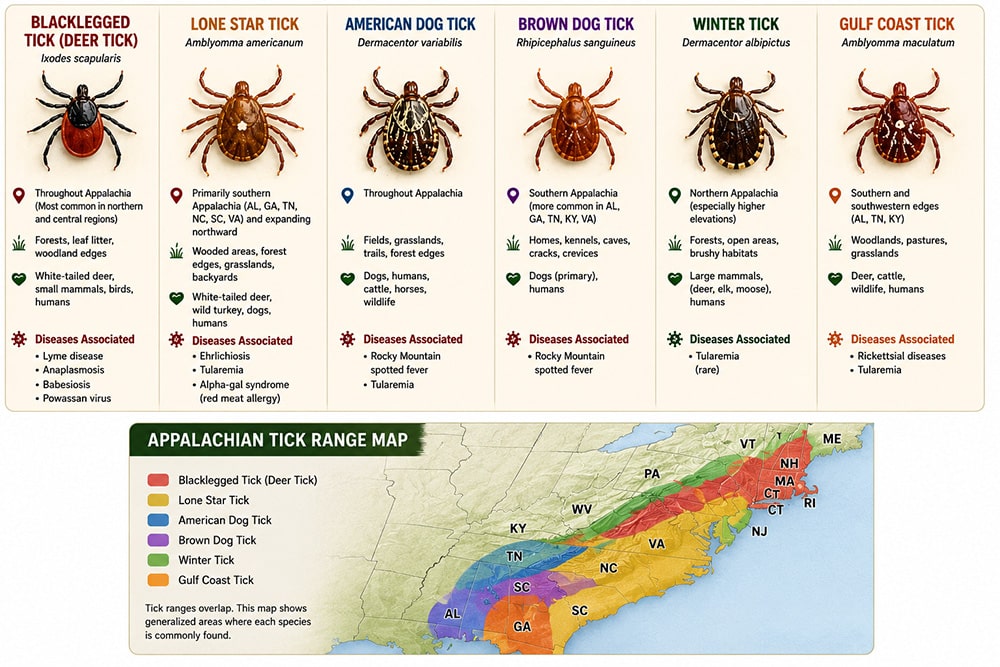

How Ticks Get on You
Ticks do not jump. They do not fly. Most do not drop from trees.
Instead, they wait in ambush.
Contrary to popular belief, ticks do not usually fall from trees. Most species climb low vegetation and wait with front legs extended and waving in the air, a behavior known as “questing.” When a person or animal brushes against vegetation, the tick grabs on and begins searching for exposed skin.
Ticks are ambushers. They climb onto grass blades, weeds, low branches, and brush along trails. As animals–deer, squirrels, hikers–brush against vegetation, ticks latch onto clothing, fur, or exposed skin. Then they crawl upward, looking for a warm, protected spot to settle in and have lunch.
Common attachment points include:
- Ankles
- Behind knees
- Waistbands
- Groin area
- Armpits
- Hairline
- Behind ears
Silent and undetectable blood-suckers.
You might feel a tick as it crawls–surprisingly quickly–up your leg or arm. But, as with mosquitoes, tick saliva contains compounds that reduce pain and irritation, so many who are bitten don’t realize it. Unlike mosquitoes, ticks don’t just bite and take off. They have mouth parts that scissor into the host’s skin before insertion of a barbed feeding tube. To make removal even more difficult, ticks often secrete a cement-like substance that super-glues them in place.
Once in place, the tick hangs on, feeding and expanding from a flat body measuring 0.3 cm into a bulbous, blood-filled oval that might be more than a centimeter wide.
What To Do If You Find a Tick
Ticks and spiders are related (both are in the arachnida family), so perhaps it isn’t surprising that both elicit the same reaction when spotted. For many people, it is instant panic. Maybe a shriek. Many go straight to Google to find out what to do next.
First, is the tick walking around or has it attached?
If the tick hasn’t attached to the skin, it’s easy enough to pick it up (with your fingers or in a tissue) and dispose of it. Most captured ticks go the way of dead goldfish: down the toilet. That’s a safe way to get rid of it because ticks are notoriously difficult to kill otherwise.
If the tick is attached.
There is a lot of folk medicine associated with tick removal. Most of it is wrong. “Using matches or nail polish remover or Vaseline ─ you want to avoid those,” says Dr. Bobbi Pritt, a Mayo Clinic parasitic diseases expert. The Mayo Clinic and the Centers for Disease Control both advocate the following process for removing a tick.
Proper Removal Steps
- Use fine-tipped tweezers
- Grasp close to skin (do not grab the body; it will detach from the mouthparts)
- Pull steadily upward (twisting can break off mouthparts)
- Clean bite area
- Monitor symptoms
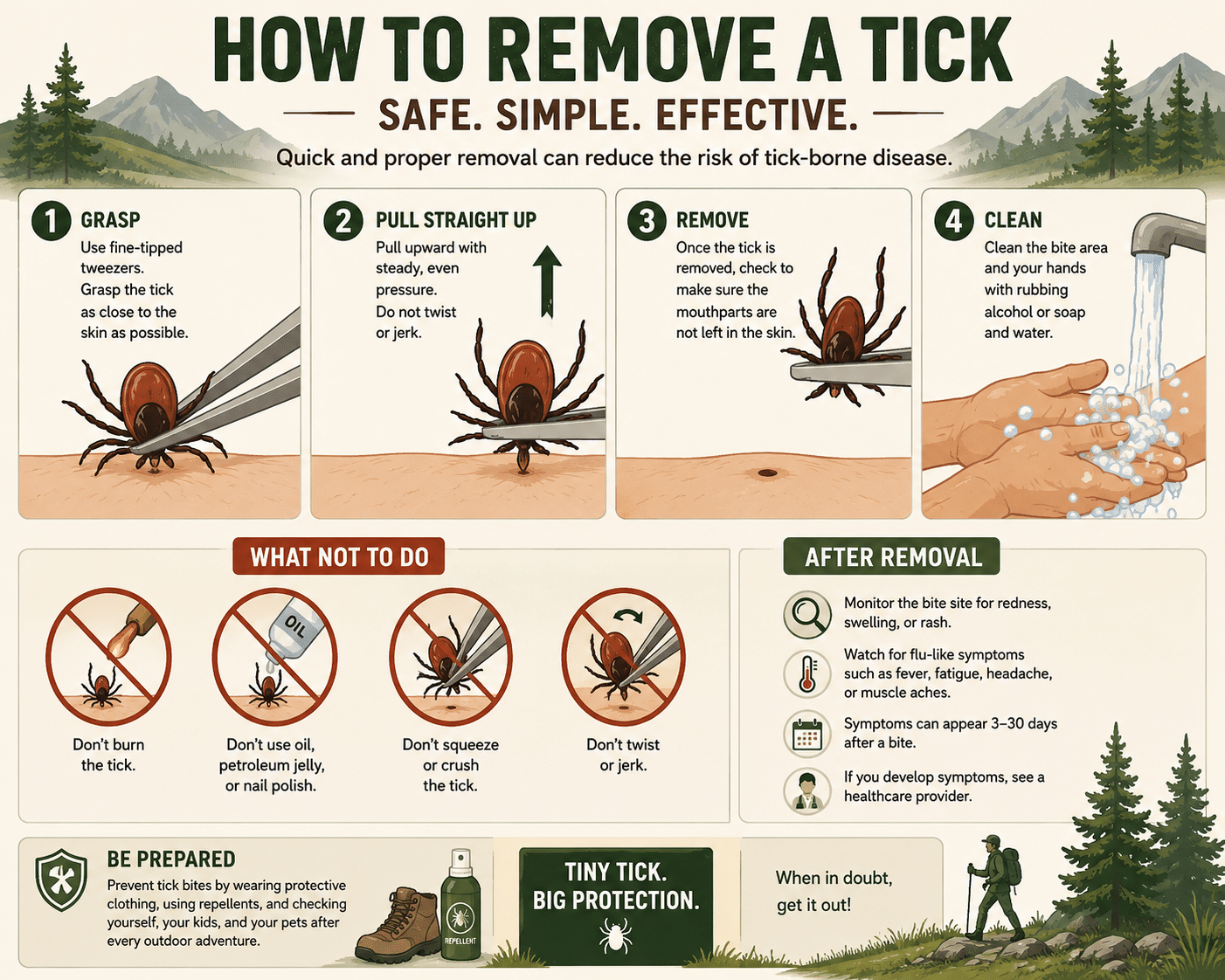
Do not:
- Burn the tick off – many a tick has been singed by cigarettes. Don’t do this. It doesn’t even seem to be a good idea!
- over it in petroleum jelly – ticks breathe only a few times per hour, so being covered up doesn’t necessarily break their stride. It might panic the, however, causing them to regurgitate contaminiates into the open wound.
- Twist violently – this can break off the tick’s mouthparts, which can cause a localized infection,
Some people save ticks in sealed containers for identification if symptoms develop later.
Important note: even if a tick carries Lyme disease bacteria, transmission is not guaranteed. In many cases, a tick must remain attached for 24–36 hours before transmission risk rises significantly.
Tick Bite Statistics in Appalachia and the United States
Estimated Annual Numbers
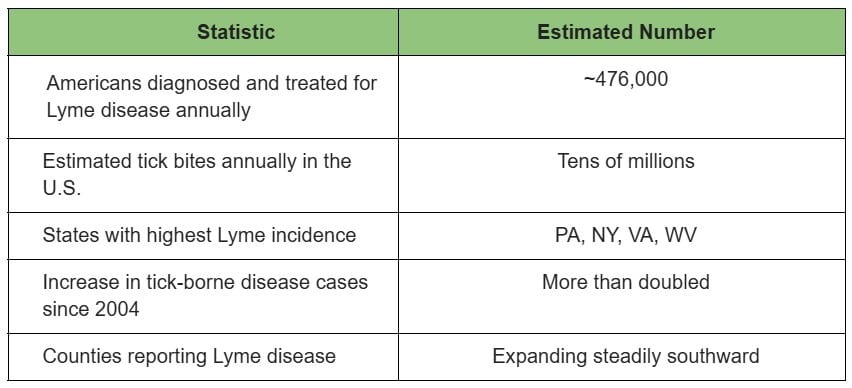
According to the CDC, reported tick-borne illnesses have increased significantly over the past two decades.
Tick Folklore, Rumors, and Conspiracy Theories
Some simple misconceptions that are not true include:
- You can catch Lyme disease by a tick being on your body.
- All deer ticks carry Lyme disease.
- All bites by ticks transfer disease.
- Ticks jump from trees onto the heads of passing hikers.
Throughout Appalachia, across the American Midwest, and in rural Canada, stories circulate about “tick boxes” being dropped from planes or deliberately released into the wild. These theories are stated as fact on social media.
One variation of this story is that Bill Gates is secretly bankrolling the tick box operation. At the same time, he is funding research into a Lyme Disease vaccine. To date (May 2025), there is no proof of either of these theories.
Other theories point to Plum Island Animal Disease Center off the coast of New York. Still other suggest ticks were used in Cold War biological warfare research in the area of Lyme, Connecticut, hence the concentration of Lyme disease in that region.
Still, the rumors persist, fueled in part by the post-COVID-19 era’s erosion of trust in governments worldwide, the US Centers for Disease Control, the World Health Organization, and billionaires in general. Appalachia and, indeed, most parts of rural America, is known for a longstanding skepticism toward government institutions. In the mountain communities, where oral storytelling traditions remain strong, people are more likely to believe their neighbors over the government.
What is real is the rapid increase in tick populations and tick-borne illnesses.
Like many Appalachian legends, the stories endure because they blend fear, uncertainty, and fragments of reality.
Common Tick Secies in Appalachia
Blacklegged Tick (Deer Tick)


The blacklegged or deer tick is the primary carrier of Lyme disease in the eastern United States. It is most common in northern and central Appalachia, including Pennsylvania, West Virginia, Virginia, and parts of Kentucky and Tennessee.
Diseases Associated
- Lyme disease
- Anaplasmosis
- Babesiosis
- Powassan virus
- Risk Notes
Not every deer tick carries Lyme disease. Infection rates vary significantly by region. In parts of the Northeast, more than 40% of blacklegged ticks may carry Lyme-causing bacteria. In portions of southern Appalachia, rates are generally lower but still significant.
Lone Star Tick


Recognizable by the white dot on the female’s back, the lone star tick has become one of the most common ticks in southern Appalachia.
Diseases Associated
- Ehrlichiosis
- Tularemia
- Alpha-gal syndrome
Risk Notes
This tick is aggressive and actively seeks hosts. Many hikers in the Southeast encounter lone star ticks more frequently than deer ticks.
American Dog Tick


Also called the wood tick, these are common along trails and grassy areas throughout Appalachia.
Diseases Associated
- Rocky Mountain spotted fever
Tularemia
Despite the name, these ticks readily bite humans.
Diseases Spread by Appalachian Ticks
Lyme Disease
Lyme disease is the most famous of the tick-born illnesses. It’s caused by the bacterium Borrelia burgdorferi and spread primarily by blacklegged ticks, commonly called deer ticks. According toe the American Lyme Disease Foundation, only between 1% and 5% of deer tick bites result in a transfer of the bacteria that causes Lyme disease.
Symptoms
- Neurological complications
- Fever
- Joint pain
- Fatigue
- Bullseye rash (not always present)

(Source: American Lyme Disease Foundation, https://aldf.com/lyme-disease/)
Rocky Mountain Spotted Fever
Despite the name, RMSF is common in the Southeast.
Symptoms
- Fever
- Rash
- Severe headache
- Muscle pain
Untreated RMSF can become life-threatening.
Ehrlichiosis
Increasingly common in southern Appalachia.
Symptoms
- Fever
- Fatigue
- Chills
- Confusion
Tularemia
Tularemia is a bacterial disease sometimes associated with tick bites, particularly from lone star ticks and dog ticks.
It can also spread through contact with infected animals, especially rabbits.
Symptoms
- Fever
- Skin ulcers
- Swollen lymph nodes
- Fatigue
- Respiratory complications in severe cases
While relatively uncommon, tularemia can become serious if untreated.
Powassan Virus: A Growing Concern
Powassan virus is rare but increasingly discussed by researchers because of its severity.
Unlike Lyme disease bacteria, which may require many hours of attachment before transmission, Powassan virus may spread much more quickly after a tick bite.
Symptoms
- Fever
- Headache
- Vomiting
- Neurological complications
- Encephalitis
Cases remain uncommon, but concerns are rising in parts of northern Appalachia and the Northeast.
Alpha-Gal Syndrome: The Strange Allergy Linked to Ticks
One of the most unusual conditions associated with Appalachian ticks is alpha-gal syndrome, and cases are on the rise.
This condition, linked primarily to lone star tick bites, occurs when the alpha-gal molecule introduced into the body of a human. The molecule, which is found in animals such as cows and pigs, is attacked by the human immune system. This can then trigger an allergic reaction to mammalian meat products including beef, pork, and venison. Some patients also react to dairy products or gelatin. Unlike typical food allergies, reactions may occur several hours after eating.
While it is a hot topic in the news and on social media as of this writing in 2026, it is not a new condition. The Centers for Disease Control reports that there are 110,000 cases of Alpha-Gal Syndrome in the United States. However, since instances are not mandatory to report to the CDC, estimates of cases run as high as 450,000.
Researchers are still studying why tick bites trigger the immune response.
Babesiosis
The Cause: Transmitted by the blacklegged (deer) tick.
The Condition: A parasitic disease that infects and destroys red blood cells.
The Range: Historically limited to the Northeast and Upper Midwest, researchers have documented a growing number of cases in mid-Atlantic states like Delaware, Maryland, and Virginia.
The Symptoms: Flu-like symptoms, including fever, chills, fatigue, and dark urine.
Rickettsia parkeri Rickettsiosis
The Cause: Transmitted by the Gulf Coast tick.
The Condition: An emerging spotted-fever illness historically found in the Southeast, which scientists have recently identified as far north as the Northeast.
The Symptoms: Causes flu-like symptoms and a rash, though it is generally milder than Rocky Mountain Spotted Fever.
New Research on Ticks
Researchers continue studying how tick populations and diseases are changing.
Areas of current research include:
- Climate change and tick expansion
- Genetic differences in Lyme bacteria
- New tick-borne viruses
- Alpha-gal syndrome mechanisms
- Tick saliva compounds
- Wildlife host interactions
Scientists have documented expanding ranges for several tick species, particularly in warmer parts of Appalachia.
Milder winters appear to improve tick survival rates.
Preventing Tick Bites
The good news is that tick bites are often preventable. In regions where ticks are common, anyone spending time in forested or grassy areas needs to adopt habits that deter ticks. Obviously, avoid plants likely to host questing ticks. Hikers, hunters, and other outdoorspeople are more likely to be in areas where ticks live, so they need to dress appropriately and avoid brushing against low vegetation.
For a detailed look at how to avoid ticks while in the Appalachian Mountains, check out our blog called Safe Hiking in Tick Territory.
Clothing Tips
- Wear light-colored clothing to aid in spotting ticks
- Tuck pants into socks
- Wear long sleeves in brushy areas
- Avoid sandals in tall grass
Repellents
Use EPA-approved repellents:
- DEET
- Picaridin
- Permethrin-treated clothing
- Permethrin is a topical repellent for clothing only. It should never be applied directly to skin. It lasts for a long time (or several washings) on fabric.
Trail Behavior
- Stay near trail center
- Avoid brushing vegetation
- Avoid sitting directly on logs or leaf litter
- Check yourself, pets, and children frequently
After the Hike
- Shower within two hours
- Inspect entire body carefully
- Check scalp and behind ears
- Wash clothing in hot water (for clothing treated with permethrin, you can toss them in the dryer at high temperature instead of washing them.
- Examine pets thoroughly
Final Thoughts
The Appalachian Mountains remain one of America’s great outdoor destinations. Millions hike, camp, fish, paddle, and explore the region every year without serious incident. Most dangers in Appalachia are not mythical. They are practical. Preparation can keep you safe.
Although ticks are found throughout Appalachia, they should not keep people out of the woods. They should be taken seriously, however.
Understanding how ticks behave, where they live, and how to prevent bites dramatically reduces risk.
The mountains reward awareness. Visitors who respect the environment, prepare properly, and pay attention to small details usually fare well in the Appalachian woods.
https://newsnetwork.mayoclinic.org/discussion/mayo-clinic-minute-tick-removal-dos-and-donts-2/
Centers for Disease Control and Prevention (CDC) Tick Resources
National Institutes of Health Alpha-Gal Syndrome Information
U.S. Environmental Protection Agency Tick Repellent Guidance
https://aldf.com/lyme-disease/
https://time.com/article/2026/03/30/bad-tick-season-how-to-prevent-lyme-disease/
https://www.youtube.com/watch?v=3eWLLtR2SFc
Portions of the imagery used in this article are sourced from the Centers for Disease Control and Prevention (CDC), National Park Service (NPS), USDA Forest Service, U.S. Fish & Wildlife Service, and Wikimedia Commons public-domain collections.


0 Comments