
Eastern Hemlock
Tsuga canadensis
Introduction
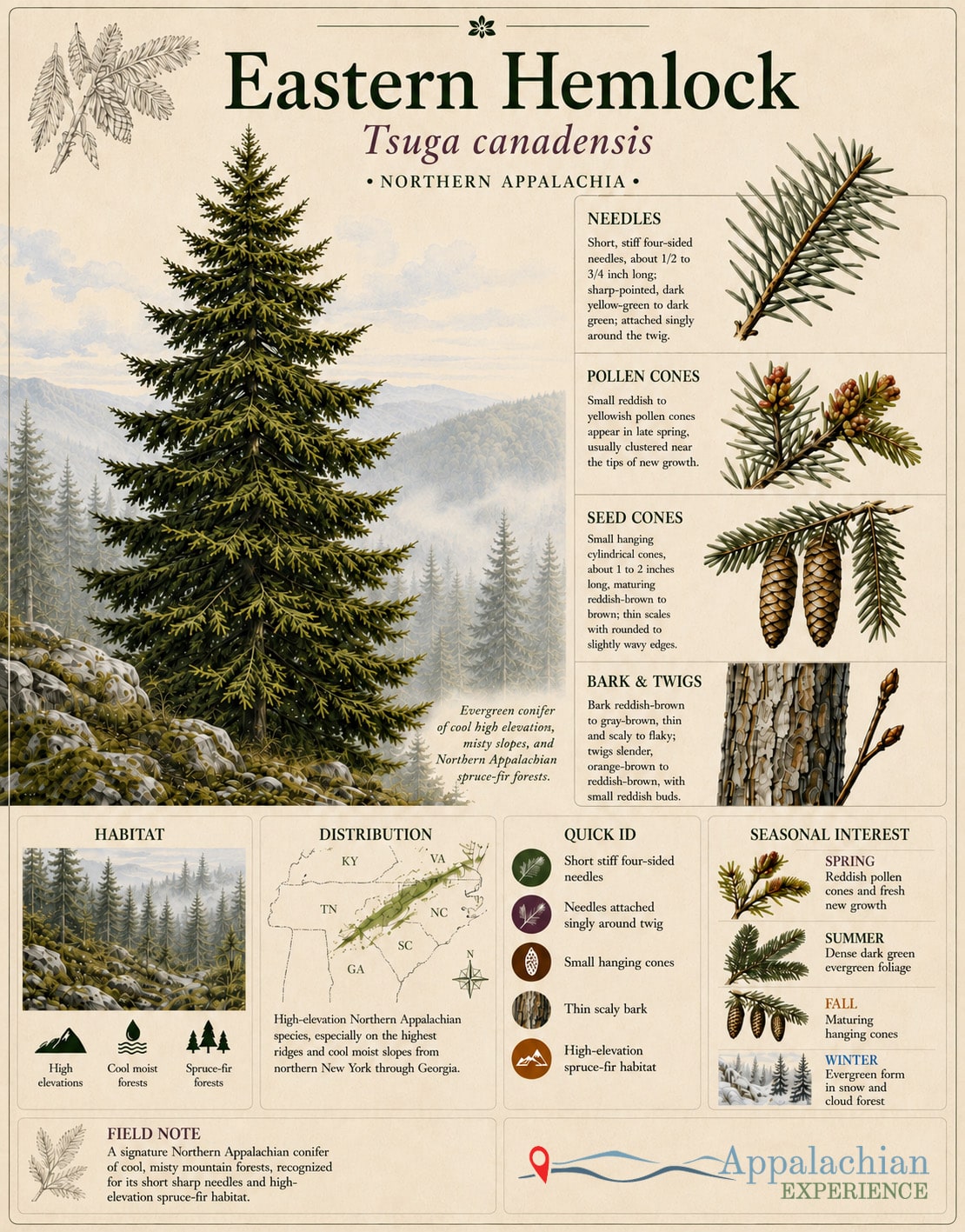
Eastern hemlock is the evergreen shade of Northern Appalachian ravines. It darkens stream corridors, cools water, and gives steep gullies a different climate from the surrounding hardwood slopes.
Quick Facts
Common Name
Scientific Name
Family
Plant Type
Typical Size
Flowers / Pollen Cones
Fruit / Seed /Seed Cones
Common Habitat
Caution
Eastern Hemlock
Tsuga canadensis
Pinaceae, the pine family
Evergreen conifer
Often 60 to 100 feet tall
Small cones
Small hanging cones
Cool ravines, stream corridors, north slopes, and hemlock-hardwood forests
Hemlock woolly adelgid has damaged many stands; dead trees can be hazardous
Where it Grows
In Northern Appalachia, hemlock grows in ravines, stream valleys, rocky slopes, and hemlock-northern hardwood forests. It mixes with yellow birch, beech, red maple, white pine, and sugar maple.
How to Identify It
Look for short flat needles with pale lines below, slender twigs, drooping branch tips, tiny hanging cones, and dark ridged bark on older trees.
Importance to the Appalchia Ecosystem
Hemlock shades streams, moderates temperature, shelters wildlife, and creates cool moist habitat. Its loss changes light, temperature, and moisture in ravines and stream corridors.
More trees...
Northern Appalachia
Southern Appalachia
Human Uses
Hemlock bark was once used heavily for tannin. The wood has been used for rough lumber, pulp, and crates. Today, its ecological role is often its greatest value.
Interesting Facts
It is one of the most shade-tolerant eastern trees.
Its small cones separate it from many other conifers.
Hemlock decline changes stream habitat.
Look-Alikes
Hemlock can be confused with fir and spruce. Hemlock needles are flat and soft with tiny hanging cones. Spruce needles are sharp and four-sided. Fir cones stand upright.
Cautions and Common Problems
Hemlock woolly adelgid is the main threat. Dead hemlocks can become dangerous along trails, driveways, and streams.
Seasonal Interest
Spring brings pale new growth. Summer gives deep shade. Fall and winter leave hemlock green after hardwood leaves drop.
In the Appalachian Landscape
Eastern hemlock changes the temperature of the forest. A hemlock ravine feels quieter, cooler, and closer than the open hardwood slope above it.
Sources and Further Reading
- U.S. Forest Service Silvics of North America, Eastern Hemlock. https://research.fs.usda.gov/silvics/eastern-hemlock
Last reviewed: 2026-10-07
Northern Appalachian Trees
Southern Appalachian Trees
Start your journey today at Appalachian Experience—where adventure meets tradition.
Get the Appalachian Experience Newsletter
Unlock the wonders of the Appalachian Mountains! Subscribe to our newsletter for the latest updates on attractions, events, and hidden gems. Follow us on social media to stay inspired by the beauty and adventure that awaits. Join our community today!