
White Oak
Quercus alba
Introduction
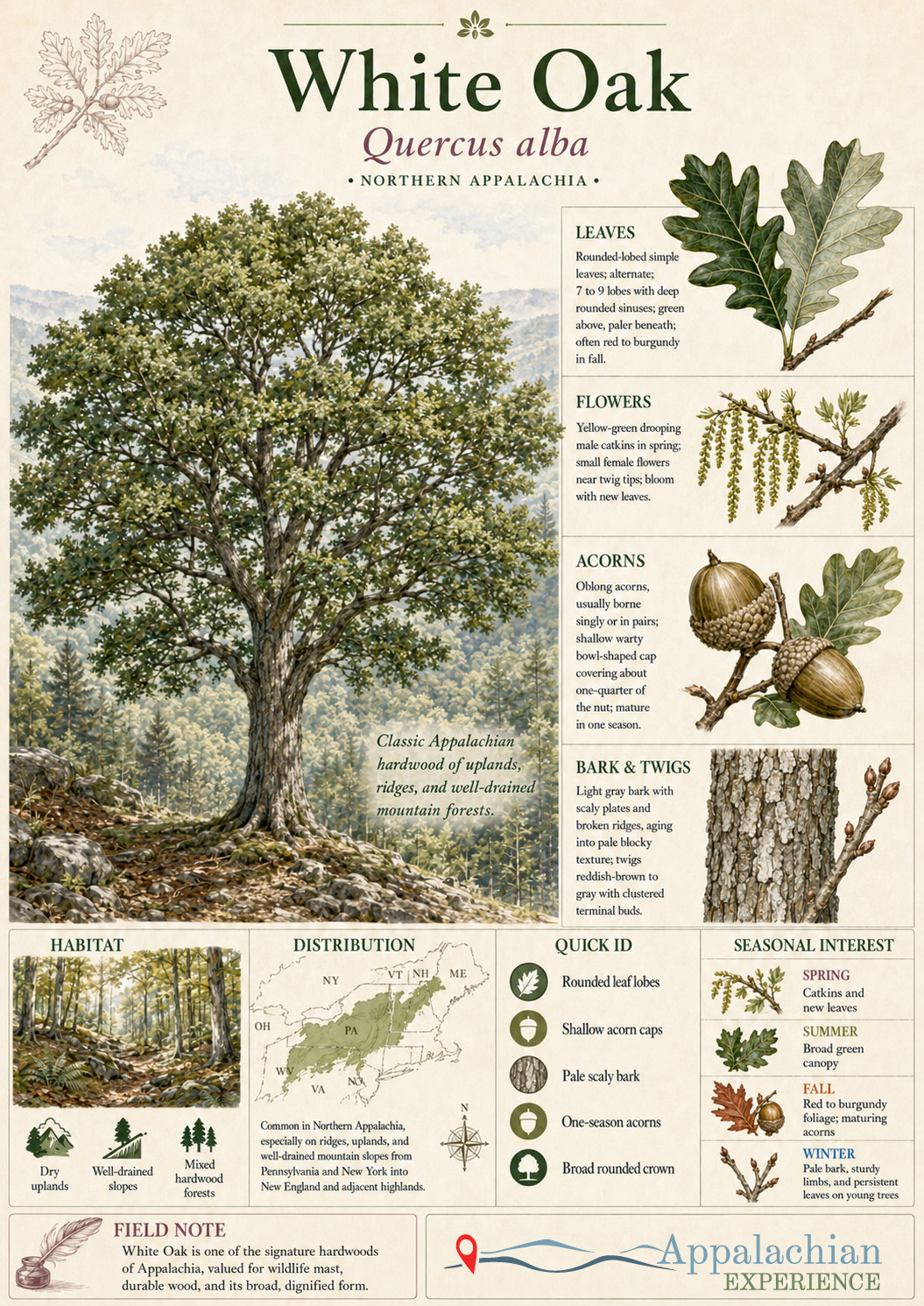
White oak reaches well into Northern Appalachia, especially on warmer slopes, ridges, and mixed hardwood sites. Its pale bark and rounded leaves separate it from the pointed red oak group.
Quick Facts
Common Name
Scientific Name
Family
Plant Type
Typical Size
Flowers / Pollen Cones
Fruit / Seed /Seed Cones
Common Habitat
Caution
White Oak
Quercus alba
Fagaceae, the beech family
Deciduous hardwood tree
Often 60 to 100 feet tall
Spring catkins
Acorns that mature in one season
Warmer slopes, ridges, mixed hardwoods, and oak forests
No major public safety caution; acorns can be slick underfoot
Where it Grows
In Northern Appalachia, white oak is commoner in lower, warmer, and drier parts of the region, especially Pennsylvania and southern New York. It mixes with red oak, chestnut oak, hickories, red maple, and white pine.
How to Identify It
Look for rounded lobes, pale gray bark, and acorns with shallow cups. Leaves do not have bristle tips. Older bark can look blocky and light compared with red oaks.
Importance to the Appalchia Ecosystem
White oak acorns are major wildlife food. The tree supports insects and adds long-lived canopy structure to upland forests.
More trees...
Northern Appalachia
Southern Appalachia
Human Uses
White oak wood is used for barrels, flooring, furniture, cabinets, boat work, and outdoor uses where rot resistance matters.
Interesting Facts
Its acorns mature in one year.
The wood is preferred for barrels because of its closed cellular structure.
It can live for centuries.
Look-Alikes
White oak can be confused with other white oak group species. Rounded lobes and pale bark are the first clues. Chestnut oak has toothed leaves, not lobed leaves.
Cautions and Common Problems
Oak decline, drought, heavy browse, and poor regeneration are concerns. Mature trees should be protected where possible.
Seasonal Interest
Spring brings catkins. Summer shows rounded leaves. Fall brings russet, wine, or brown color. Winter bark and acorns aid identification.
In the Appalachian Landscape
White oak adds a warmer upland note to Northern Appalachia. It carries the oak-hickory character northward into ridges and lower slopes.
Sources and Further Reading
- U.S. Forest Service Silvics of North America, White Oak. https://research.fs.usda.gov/silvics/white-oak
Last reviewed: 2026-10-07
Northern Appalachian Trees
Southern Appalachian Trees
Start your journey today at Appalachian Experience—where adventure meets tradition.
Get the Appalachian Experience Newsletter
Unlock the wonders of the Appalachian Mountains! Subscribe to our newsletter for the latest updates on attractions, events, and hidden gems. Follow us on social media to stay inspired by the beauty and adventure that awaits. Join our community today!