
Red Spruce
Picea rubens
Introduction
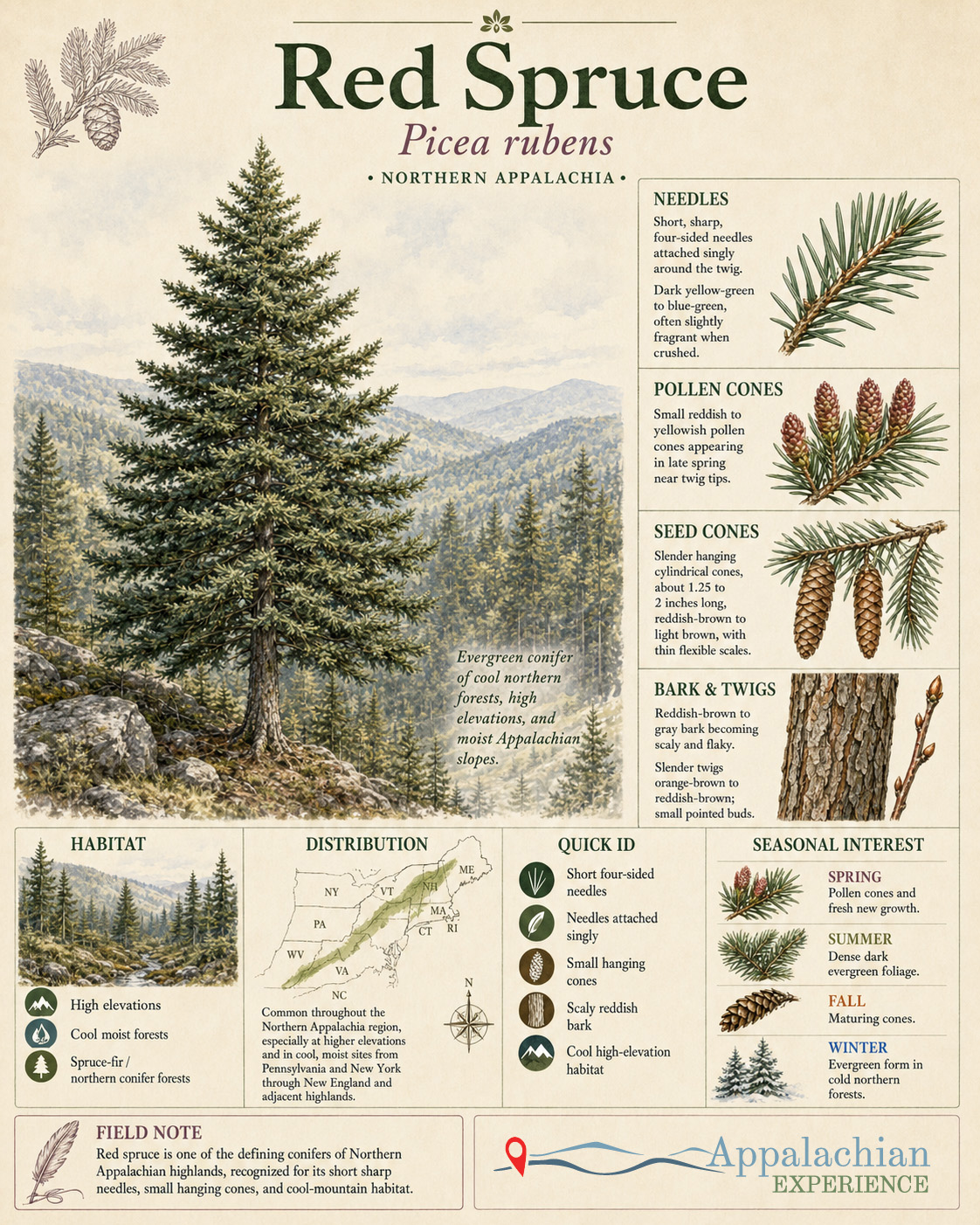
Red spruce is a northern mountain tree with a dark, narrow presence. In Northern Appalachia it forms spruce-fir forests, mixes with northern hardwoods, and gives cold ridges and high slopes their conifer edge.
Quick Facts
Common Name
Scientific Name
Family
Plant Type
Typical Size
Flowers / Pollen Cones
Fruit / Seed /Seed Cones
Common Habitat
Caution
Red Spruce
Picea rubens
Pinaceae, the pine family
Evergreen conifer
Often 60 to 90 feet tall
Pollen cones and seed cones
Small hanging cones
Cool high-elevation forests, spruce-fir woods, bog edges, and northern slopes
Sensitive high-elevation and wetland habitats should be protected
Where it Grows
In Northern Appalachia, red spruce grows in high-elevation forests, cool slopes, wetlands, and spruce-fir communities. It often mixes with balsam fir, yellow birch, paper birch, mountain ash, and hemlock.
How to Identify It
Look for sharp four-sided needles attached singly around the twig, small hanging cones, scaly bark, and a narrow evergreen crown. Needles roll between the fingers.
Importance to the Appalchia Ecosystem
Red spruce helps build cold, moist forest habitat. It shades headwaters, stores snow, protects soils, and supports specialized plants and animals of high-elevation forests.
More trees...
Northern Appalachia
Southern Appalachia
Human Uses
The wood has been used for lumber, pulp, and musical soundboards. Red spruce also has restoration and conservation value in high-elevation forests.
Interesting Facts
Spruce needles are sharp and four-sided.
Red spruce can live in cold, wet, high-elevation forests.
It is an important tree in spruce-fir forest recovery work.
Look-Alikes
Red spruce can be confused with balsam fir and hemlock. Spruce has sharp four-sided needles and hanging cones; fir has flatter needles and upright cones.
Cautions and Common Problems
Past logging, fire, acid deposition, and climate stress have affected red spruce forests. High-elevation soils are easily damaged.
Seasonal Interest
Spring brings pale new growth. Summer holds dark green canopy. Fall contrasts spruce with hardwood color. Winter shows its form in snow and fog.
In the Appalachian Landscape
Red spruce gives Northern Appalachia its dark high-country edge: cold air, tight needles, wet moss, and a forest that feels closer to Canada than valley farm country.
Sources and Further Reading
- U.S. Forest Service Silvics of North America, Red Spruce. https://research.fs.usda.gov/silvics/red-spruce
Last reviewed: 2026-10-07
Northern Appalachian Trees
Southern Appalachian Trees
Start your journey today at Appalachian Experience—where adventure meets tradition.
Get the Appalachian Experience Newsletter
Unlock the wonders of the Appalachian Mountains! Subscribe to our newsletter for the latest updates on attractions, events, and hidden gems. Follow us on social media to stay inspired by the beauty and adventure that awaits. Join our community today!