
Eastern White Pine
Pinus strobus
Introduction
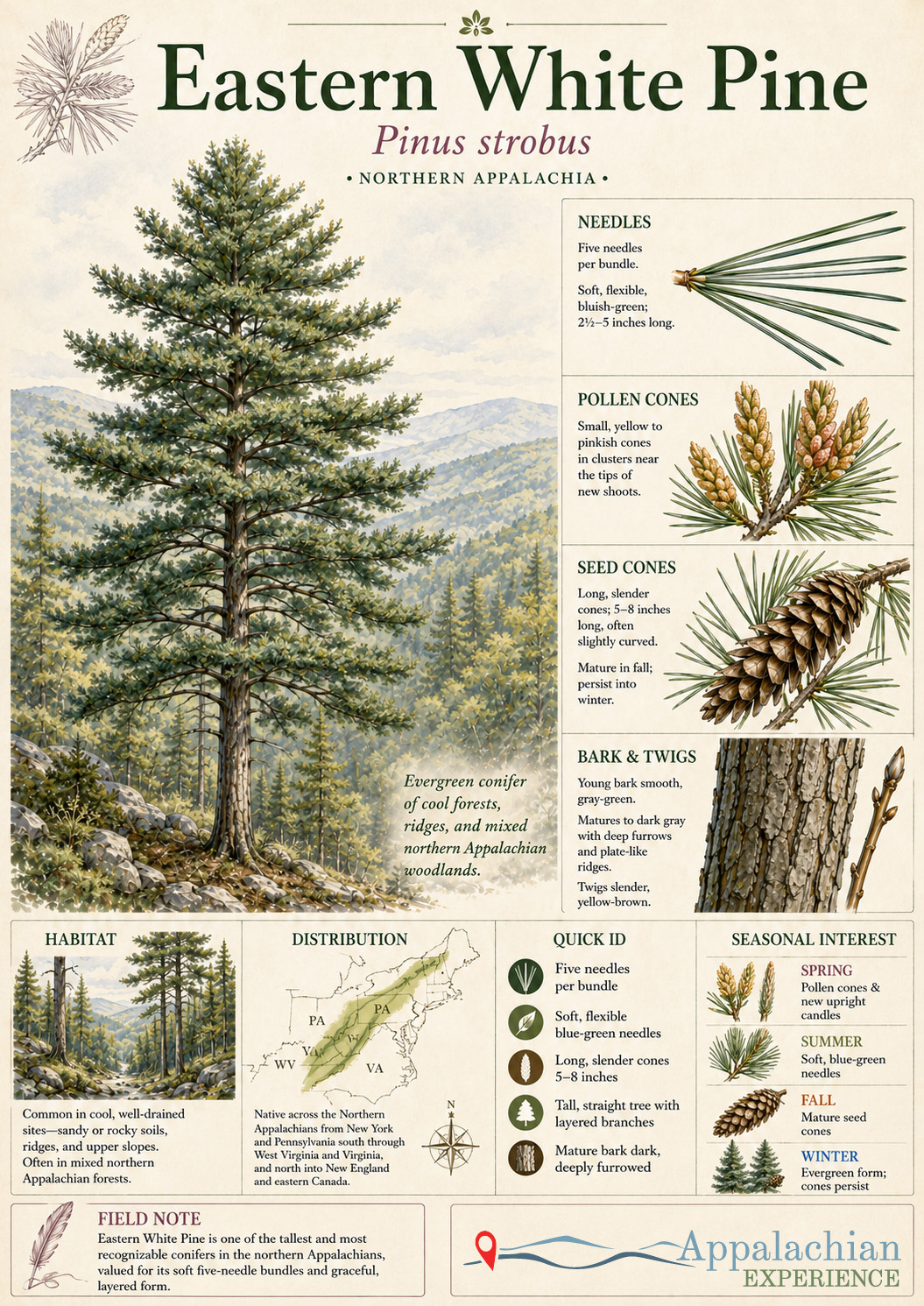
Eastern white pine is the tall soft pine of Northern Appalachia. Its five-needle bundles, long cones, and tiered crown make it easy to recognize. It can stand in old fields, mixed woods, and along rocky slopes.
Quick Facts
Common Name
Scientific Name
Family
Plant Type
Typical Size
Flowers / Pollen Cones
Fruit / Seed /Seed Cones
Common Habitat
Caution
Eastern White Pine
Pinus strobus
Pinaceae, the pine family
Evergreen conifer
Often 80 to 120 feet tall
Spring pollen and seed cones
Long narrow cones
Old fields, mixed forests, slopes, sandy soils, and pine-hardwood woods
Large limbs can fail in storms; needs space in landscapes
Where it Grows
In Northern Appalachia, white pine grows in mixed forests, former fields, sandy soils, rocky slopes, and pine-hemlock-hardwood stands. It mixes with hemlock, red oak, red maple, birches, and sugar maple.
How to Identify It
Look for five soft needles per bundle, long narrow cones, a tall straight trunk, and a layered crown. Mature bark is dark and furrowed.
Importance to the Appalchia Ecosystem
White pine provides evergreen cover, seeds for wildlife, and tall nesting structure. It can pioneer openings and persist as a long-lived canopy tree.
More trees...
Northern Appalachia
Southern Appalachia
Human Uses
The wood is light and workable and has been used for lumber, trim, furniture parts, boxes, patterns, and pulp. It was one of the major timber trees of eastern North America.
Interesting Facts
Five needles per bundle make it easy to remember.
It can become one of the tallest trees in the eastern forest.
Old pines often stand as landmarks in mixed woods.
Look-Alikes
White pine can be confused with red pine or pitch pine. White pine has five soft needles. Pitch pine has three stiff needles. Red pine has two longer needles.
Cautions and Common Problems
White pine blister rust, white pine weevil, storm breakage, and deer browse can affect trees.
Seasonal Interest
Spring brings new candles and pollen. Summer shows soft needles. Fall and winter keep white pine visible above hardwoods.
In the Appalachian Landscape
Eastern white pine gives the northern mountains height and softness at the same time. Its crown rises over fields, roadsides, and mixed woods without the hard outline of spruce.
Sources and Further Reading
- U.S. Forest Service Silvics of North America, Eastern White Pine. https://research.fs.usda.gov/silvics/eastern-white-pine
Last reviewed: 2026-10-07
Northern Appalachian Trees
Southern Appalachian Trees
Start your journey today at Appalachian Experience—where adventure meets tradition.
Get the Appalachian Experience Newsletter
Unlock the wonders of the Appalachian Mountains! Subscribe to our newsletter for the latest updates on attractions, events, and hidden gems. Follow us on social media to stay inspired by the beauty and adventure that awaits. Join our community today!