
Scarlet Oak
Quercus coccinea
Introduction
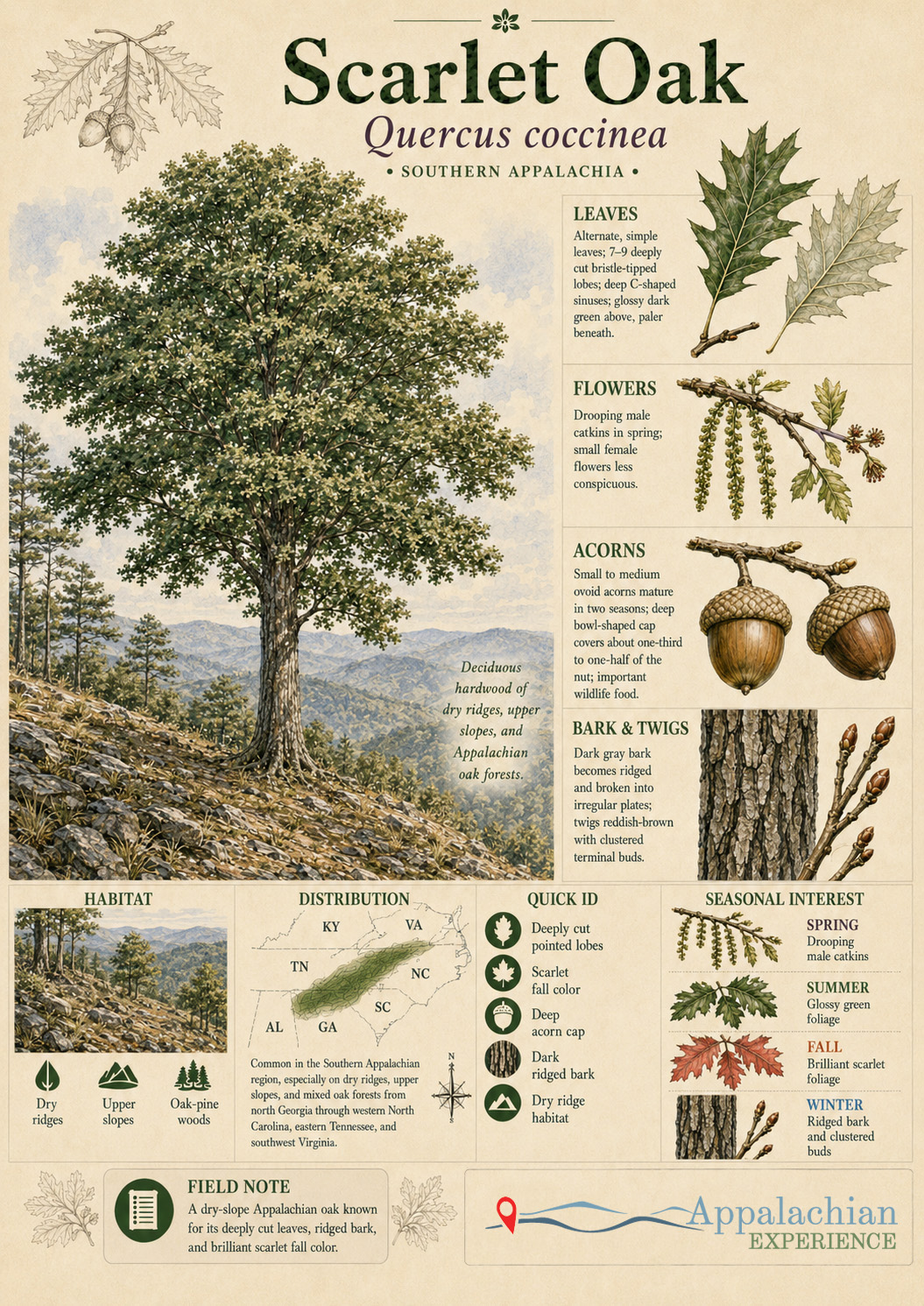
Scarlet oak brings sharp lines to dry Appalachian woods. Its leaves are deeply cut, its lobes are pointed, and its fall color can be a clean red when conditions are right. It is a tree of ridges, poor soils, and light.
Quick Facts
Common Name
Scientific Name
Family
Plant Type
Typical Size
Flowers / Pollen Cones
Fruit / Seed /Seed Cones
Common Habitat
Caution
Scarlet Oak
Quercus coccinea
Fagaceae, the beech family
Deciduous hardwood tree
Often 60 to 80 feet tall
Spring catkins
Acorns that mature over two growing seasons
Dry upland woods, ridges, sandy or rocky slopes, and oak-pine forests
No major public safety caution; acorns can be slick underfoot
Where it Grows
In Southern Appalachia, scarlet oak is common on dry ridges and upper slopes. It grows with chestnut oak, white oak, black oak, pignut hickory, sourwood, Virginia pine, and mountain laurel.
How to Identify It
Look for deeply lobed leaves with bristle-tipped points and C-shaped spaces between lobes. Acorns have caps that cover a deeper portion of the nut than northern red oak. Mature bark is dark and ridged.
Importance to the Appalchia Ecosystem
Scarlet oak produces acorns for wildlife and helps occupy dry upland sites. Its canopy supports insects, and its presence adds to the oak-dominated mast cycle that feeds many Appalachian animals.
More trees...
Northern Appalachia
Southern Appalachia
Human Uses
The wood is sold with other red oaks and used for flooring, furniture, interior finish, pallets, and fuel. It is also planted for fall color, though it needs acidic, well-drained soils.
Interesting Facts
Its fall color gives the species its common name.
The leaves are more deeply cut than many other oaks.
It is a good indicator of dry upland oak conditions.
Look-Alikes
Scarlet oak is often confused with northern red oak, black oak, and pin oak. Scarlet oak leaves are more deeply cut than northern red oak, and the acorn cap is deeper. Black oak often has yellow-orange inner bark.
Cautions and Common Problems
Oak decline, gypsy moth/spongy moth defoliation, drought stress, and fire changes can affect scarlet oak stands.
Seasonal Interest
Spring brings catkins. Summer leaves are sharply cut and glossy. Fall may bring strong red color. Winter identification uses buds, acorns, and dark bark.
In the Appalachian Landscape
Scarlet oak adds edge and brightness to the dry mountain woods. It is part of the ridge experience: light, rock, acorns, and leaves that look cut by a sharp hand.
Sources and Further Reading
- U.S. Forest Service Silvics of North America, Scarlet Oak. https://research.fs.usda.gov/silvics/scarlet-oak
Last reviewed: 2026-10-07
Northern Appalachian Trees
Southern Appalachian Trees
Start your journey today at Appalachian Experience—where adventure meets tradition.
Get the Appalachian Experience Newsletter
Unlock the wonders of the Appalachian Mountains! Subscribe to our newsletter for the latest updates on attractions, events, and hidden gems. Follow us on social media to stay inspired by the beauty and adventure that awaits. Join our community today!