
Tulip Poplar
Liriodendron tulipifera
Introduction
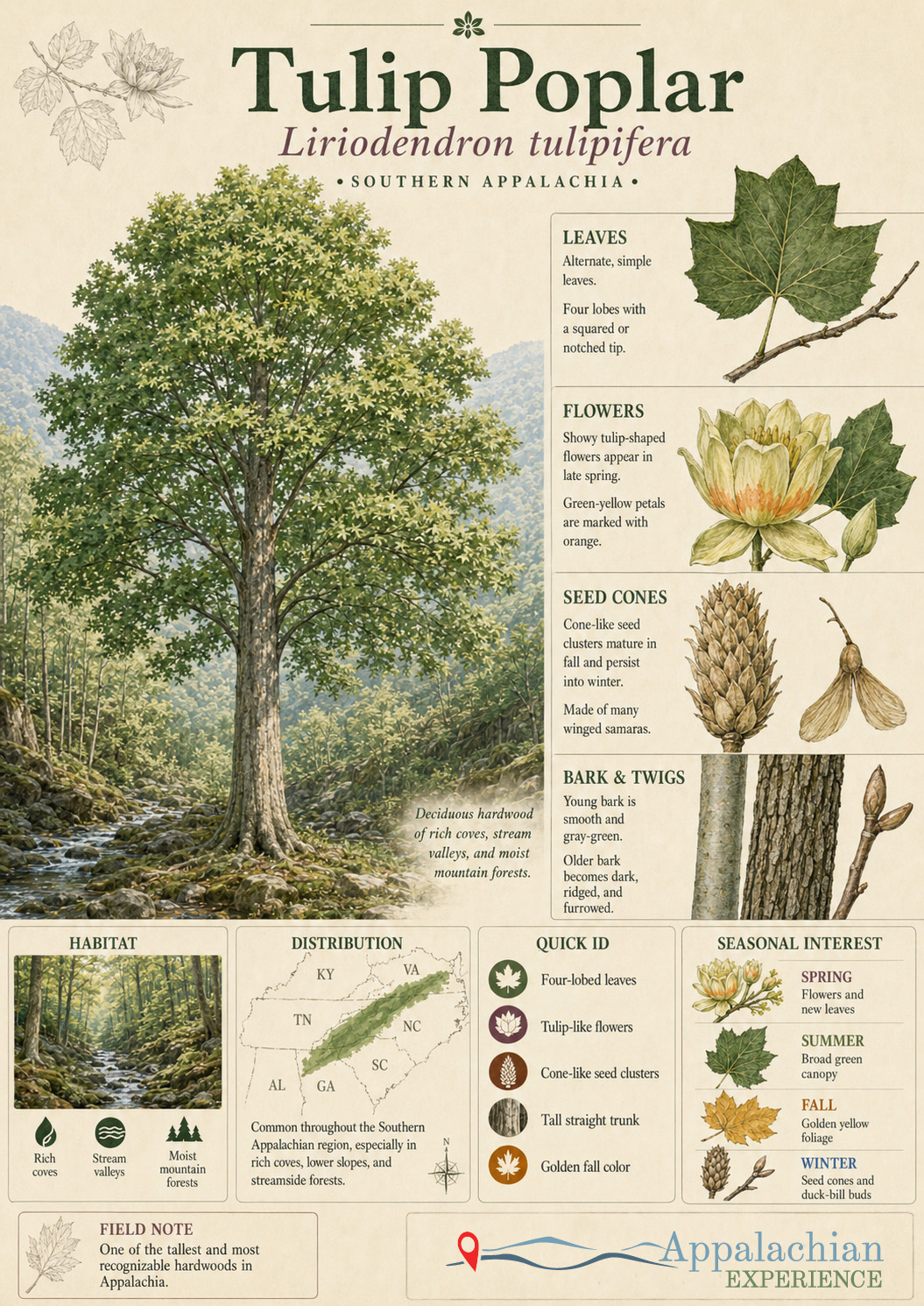
Tulip poplar is one of the signature giants of Southern Appalachian coves. Its straight trunk, high crown, and unusual leaf shape make it stand out even in a crowded forest. In rich, moist soils it can rise above surrounding hardwoods and give the cove forest much of its height.
Quick Facts
Common Name
Scientific Name
Family
Plant Type
Typical Size
Flowers / Pollen Cones
Fruit / Seed /Seed Cones
Common Habitat
Caution
Tulip Poplar
Liriodendron tulipifera
Magnoliaceae, the magnolia family
Deciduous hardwood tree
Often 80 to 120 feet tall, sometimes taller in rich coves
Tulip-shaped greenish-yellow flowers with orange markings in spring
Cone-like clusters of winged samaras
Rich coves, lower mountain slopes, deep soils, stream bottoms, and mixed mesic forests
Large limbs can break in storms; fallen flowers and leaves may be slick on walks
Where it Grows
In Southern Appalachia, tulip poplar is common in rich coves, lower slopes, moist hollows, and deep alluvial soils. It often grows with basswood, buckeye, sugar maple, beech, black birch, white ash, and hemlock.
How to Identify It
Look for a tall, straight trunk and leaves with a squared-off, tulip-like outline. The flowers are greenish-yellow with orange near the base and can be hard to see because they sit high in the canopy. Mature bark is gray and furrowed. The cone-like seed clusters persist after the leaves fall.
Importance to the Appalchia Ecosystem
Tulip poplar provides height and shade in cove forests. Its flowers supply nectar, its seeds feed wildlife, and its fast growth helps occupy canopy gaps after disturbance. It is also one of the trees that gives southern cove hardwood forests their cathedral-like scale.
More trees...
Northern Appalachia
Southern Appalachia
Human Uses
The wood is light, workable, and widely used for furniture parts, millwork, plywood, boxes, and framing. Historically, large straight trunks were used for dugout canoes. The tree is also planted as a shade tree where it has room.
Interesting Facts
It is not a true poplar; it is in the magnolia family.
The leaf shape is one of the easiest hardwood leaves to recognize.
It can live for several centuries on good sites.
Look-Alikes
The leaf shape separates tulip poplar from maples, oaks, and basswoods. Young leaves may be confused at a glance with some sassafras leaves, but tulip poplar has a more squared-off tip and a consistent form.
Cautions and Common Problems
Aphids, scale, cankers, and storm breakage can occur. In tight yards, the tree can outgrow its space. It is best treated as a forest giant or large-property shade tree.
Seasonal Interest
Spring brings flowers and fresh leaves. Summer gives broad shade. Fall usually turns the leaves yellow. Winter shows the straight trunk and persistent seed clusters.
In the Appalachian Landscape
Tulip poplar gives Southern Appalachian coves their vertical reach. Standing beneath a mature tree, a person feels the scale of deep soil, long growth, and sheltered mountain water.
Sources and Further Reading
- U.S. Forest Service Silvics of North America, Yellow-Poplar. https://research.fs.usda.gov/silvics/yellow-poplar
Last reviewed: 2026-10-07
Northern Appalachian Trees
Southern Appalachian Trees
Start your journey today at Appalachian Experience—where adventure meets tradition.
Get the Appalachian Experience Newsletter
Unlock the wonders of the Appalachian Mountains! Subscribe to our newsletter for the latest updates on attractions, events, and hidden gems. Follow us on social media to stay inspired by the beauty and adventure that awaits. Join our community today!