
Northern Red Oak
Quercus rubra
Introduction
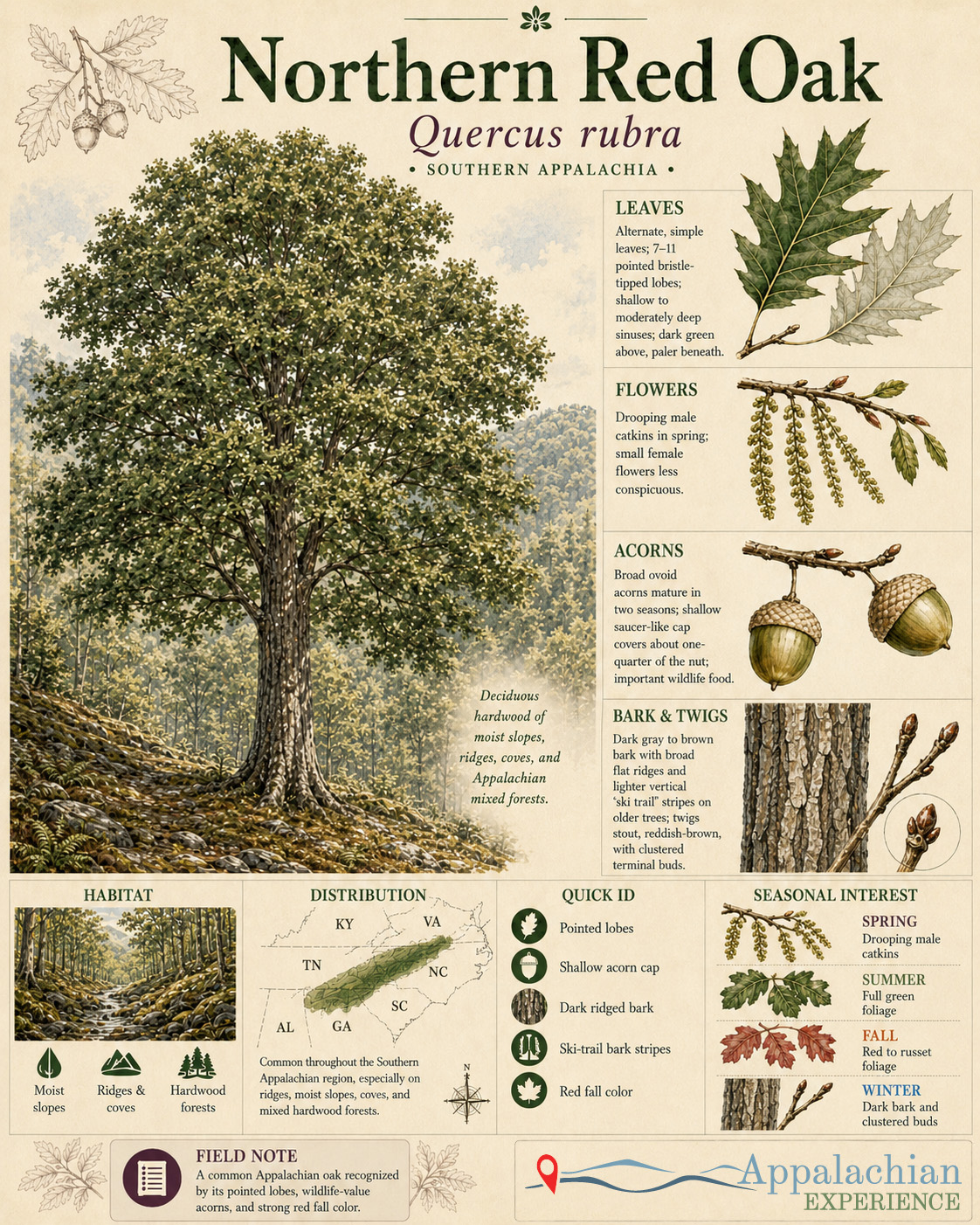
Northern red oak is one of the most familiar big oaks of the Appalachian forest. It has broad leaves with pointed lobes, large acorns, and bark that develops pale vertical ridges. On good mountain sites, it becomes a tall canopy tree with clean form.
Quick Facts
Common Name
Scientific Name
Family
Plant Type
Typical Size
Flowers / Pollen Cones
Fruit / Seed /Seed Cones
Common Habitat
Caution
Northern Red Oak
Quercus rubra
Fagaceae, the beech family
Deciduous hardwood tree
Often 70 to 100 feet tall on good sites
Spring catkins
Large acorns that mature over two growing seasons
Coves, slopes, ridges, mixed hardwood forests, and high-quality upland sites
Large acorns and limbs can be hazards under old trees; no major toxicity issue for people
Where it Grows
In Southern Appalachia, northern red oak grows on coves, slopes, and productive upland sites. It mixes with white oak, chestnut oak, red maple, hickories, black cherry, tulip poplar, and basswood.
How to Identify It
Look for leaves with pointed, bristle-tipped lobes and broad sinuses. Mature bark often shows long, pale, flat-topped ridges that can look like ski tracks. Acorns are large with shallow caps.
Importance to the Appalchia Ecosystem
Northern red oak provides mast for wildlife and supports insects in the canopy. It is a strong canopy component in mixed hardwood forests and helps bridge cove and ridge forest communities.
More trees...
Northern Appalachia
Southern Appalachia
Human Uses
The wood is a major hardwood product used for flooring, furniture, cabinets, veneer, interior trim, and railroad ties. It is also planted as a shade tree where space allows.
Interesting Facts
The pale bark ridges on mature trees are one of the best winter clues.
Its acorns take two years to mature.
It is one of the more commercially important eastern oaks.
Look-Alikes
Northern red oak can be confused with black oak and scarlet oak. Scarlet oak leaves are often more deeply cut. Black oak often has darker bark and yellow-orange inner bark. White oak group species have rounded lobes rather than bristle tips.
Cautions and Common Problems
Oak wilt, oak decline, defoliating insects, and drought stress can affect trees. Regeneration may be limited where deer browsing is heavy or shade is dense.
Seasonal Interest
Spring brings catkins and new leaves. Summer shows a broad canopy. Fall color may be red, russet, or brown. Winter identification depends on bark ridges, buds, and acorns.
In the Appalachian Landscape
Northern red oak gives Appalachian hardwood forests scale and strength. Its canopy, mast, and timber history tie it to both forest ecology and working landscapes.
Sources and Further Reading
- U.S. Forest Service Silvics of North America, Northern Red Oak. https://research.fs.usda.gov/silvics/northern-red-oak
Last reviewed: 2026-10-07
Northern Appalachian Trees
Southern Appalachian Trees
Start your journey today at Appalachian Experience—where adventure meets tradition.
Get the Appalachian Experience Newsletter
Unlock the wonders of the Appalachian Mountains! Subscribe to our newsletter for the latest updates on attractions, events, and hidden gems. Follow us on social media to stay inspired by the beauty and adventure that awaits. Join our community today!