
Sugar Maple
Acer saccharum
Introduction
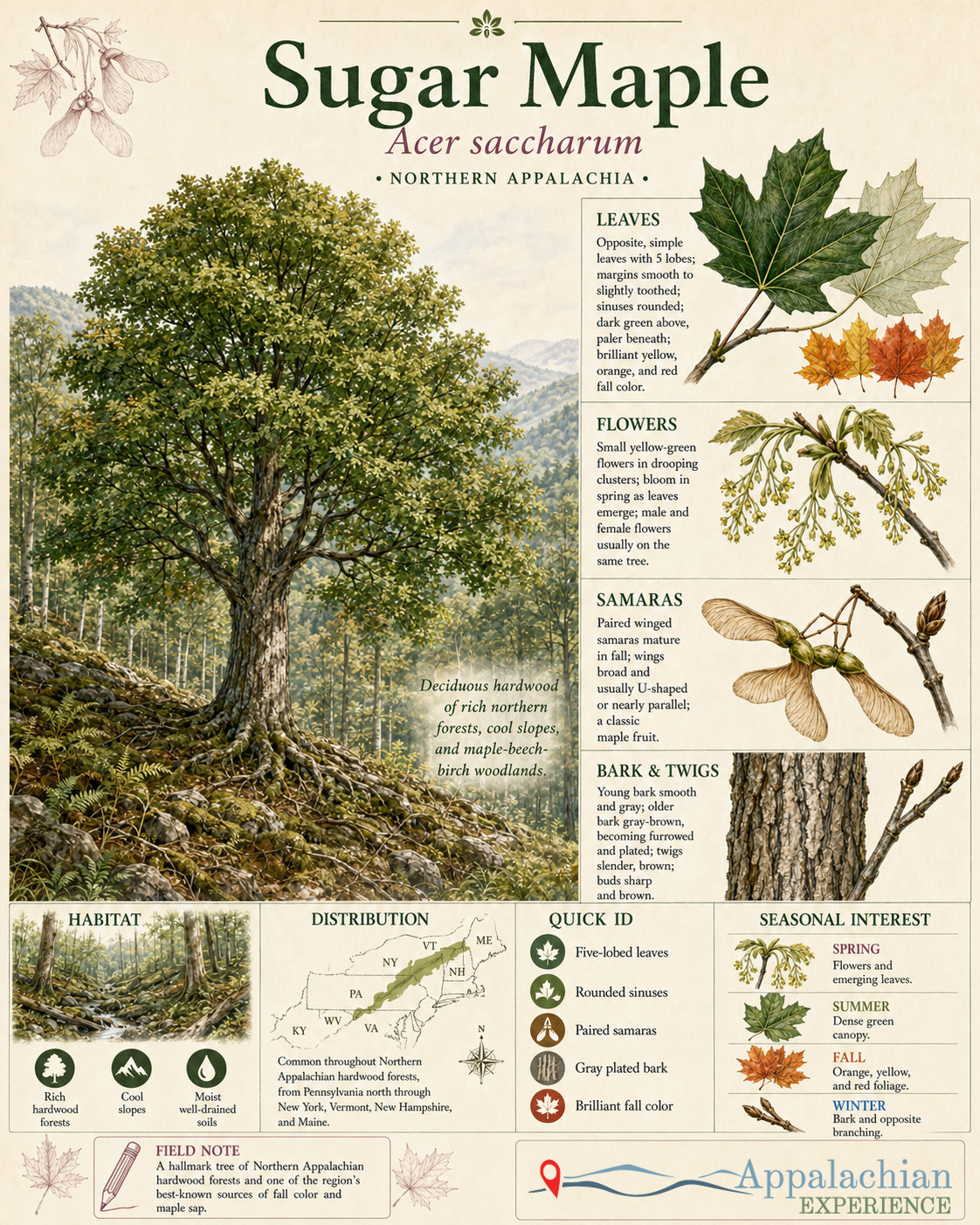
Sugar maple is one of the defining trees of Northern Appalachia. It is the maple of sugarbushes, fall color, shaded roads, and cool hardwood forests. In a northern Appalachian forest, sugar maple often sets the tone: dense shade, clean leaves, and a long connection to maple syrup.
Quick Facts
Common Name
Scientific Name
Family
Plant Type
Typical Size
Flowers / Pollen Cones
Fruit / Seed /Seed Cones
Common Habitat
Caution
Sugar Maple
Acer saccharum
Sapindaceae, the soapberry family
Deciduous hardwood tree
Commonly 60 to 90 feet tall
Small yellow-green flowers in spring
Paired winged samaras that mature in fall
Northern hardwood forests, rich slopes, coves, cool valleys, and upland woods
No major public safety caution; root systems are sensitive to compaction
Where it Grows
In Northern Appalachia, sugar maple is a core tree of the maple-beech-birch forest. It grows on rich, well-drained soils, cool slopes, coves, and uplands from Pennsylvania into New York, Vermont, New Hampshire, and Maine.
How to Identify It
Look for opposite branching, five-lobed leaves with rounded spaces between lobes, gray plated bark on mature trees, and paired samaras. Leaves usually have smoother edges than red maple.
Importance to the Appalchia Ecosystem
Sugar maple creates dense shade, feeds wildlife with seeds and buds, and contributes leaf litter that shapes forest soils. Its canopy supports insects, and its mature forests support spring wildflowers adapted to early light before leaf-out.
More trees...
Northern Appalachia
Southern Appalachia
Human Uses
Sugar maple is the main maple syrup tree. Its hard wood is used for flooring, furniture, cabinets, cutting boards, musical instruments, and turning.
Interesting Facts
It is central to maple sugaring in northern mountain culture.
Its sap has higher sugar content than many other maples.
It is a major tree of northern hardwood forests.
Look-Alikes
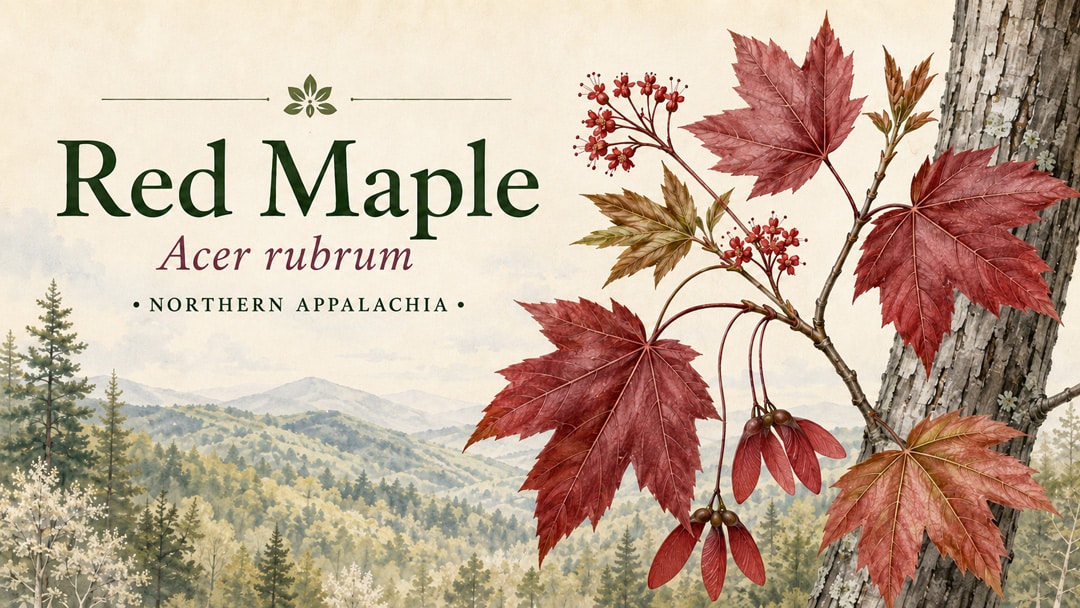
Sugar maple can be confused with red maple and Norway maple. Red maple has more toothed leaves and spring-ripening samaras. Norway maple has milky sap in the leaf stalk.
Cautions and Common Problems
Soil compaction, road salt, drought, heat, and defoliating insects can stress sugar maple. Climate shifts may reduce its advantage in warmer or drier parts of its range.
Seasonal Interest
Spring brings flowers and sap season. Summer gives deep shade. Fall brings yellow, orange, and red color. Winter shows gray bark, opposite buds, and branching form.
In the Appalachian Landscape
Sugar maple gives Northern Appalachia one of its strongest seasonal rhythms: sap rising in late winter, shade in summer, and color in fall.
Sources and Further Reading
- U.S. Forest Service Silvics of North America, Sugar Maple. https://research.fs.usda.gov/silvics/sugar-maple
Last reviewed: 2026-10-07
Northern Appalachian Trees
Southern Appalachian Trees
Start your journey today at Appalachian Experience—where adventure meets tradition.
Get the Appalachian Experience Newsletter
Unlock the wonders of the Appalachian Mountains! Subscribe to our newsletter for the latest updates on attractions, events, and hidden gems. Follow us on social media to stay inspired by the beauty and adventure that awaits. Join our community today!