
White Ash
Fraxinus americana
Introduction
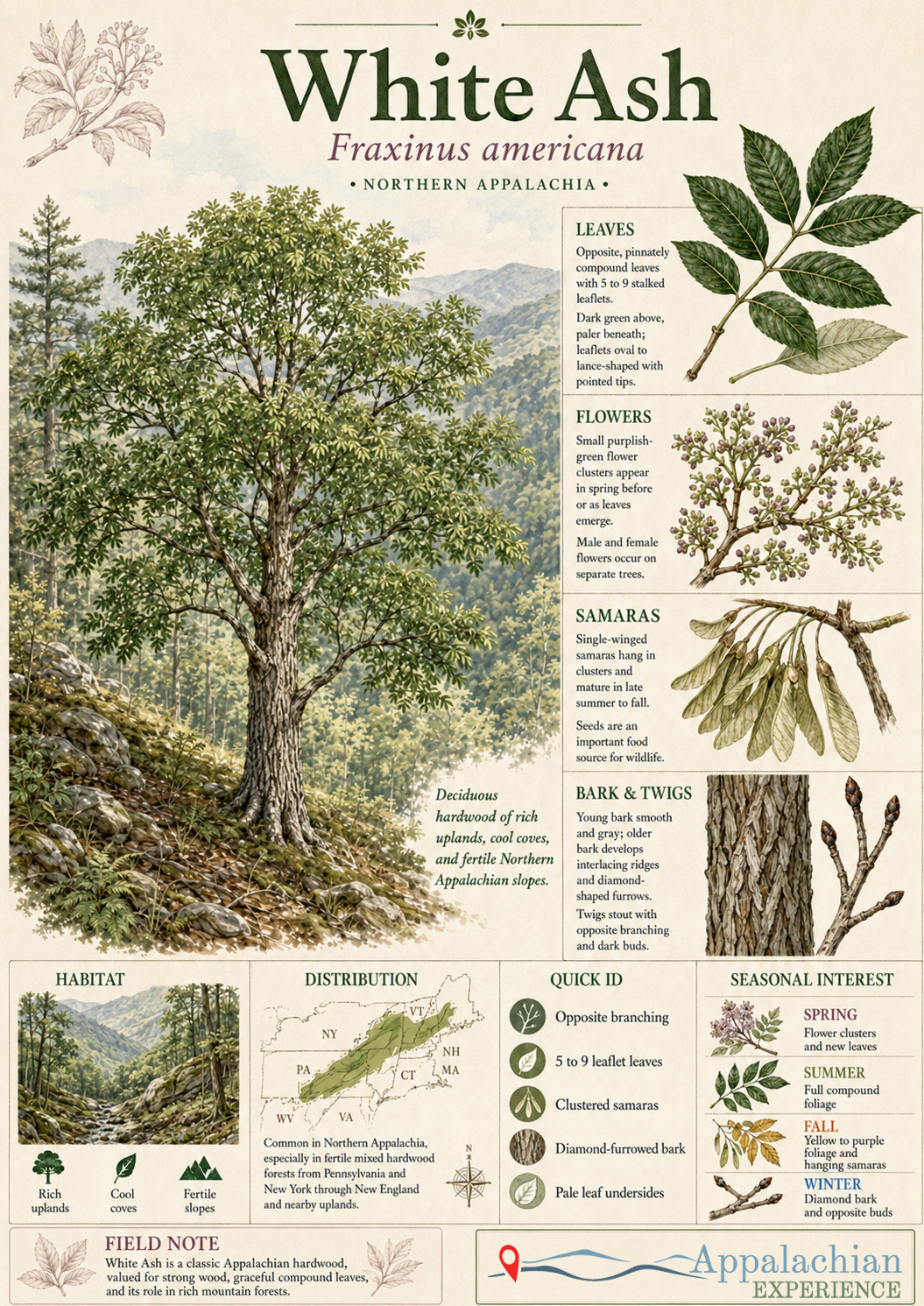
White ash was once a common, graceful hardwood of Appalachian slopes and rich woods. Its opposite branching, compound leaves, and diamond-patterned bark made it easy to recognize. Today, it also has to be discussed through the damage caused by emerald ash borer.
Quick Facts
Common Name
Scientific Name
Family
Plant Type
Typical Size
Flowers / Pollen Cones
Fruit / Seed /Seed Cones
Common Habitat
Caution
White Ash
Fraxinus americana
Oleaceae, the olive family
Deciduous hardwood tree
Often 60 to 80 feet tall
Small spring flowers
Single winged samaras in clusters
Rich woods, slopes, coves, stream terraces, and mixed hardwood forests
Emerald ash borer has caused severe ash mortality; dead ash trees become hazardous
Where it Grows
In Northern Appalachia, white ash grows on rich slopes, coves, stream terraces, and mixed hardwood sites with sugar maple, basswood, black cherry, beech, and red oak.
How to Identify It
Look for opposite branching, compound leaves usually with seven leaflets, stout twigs, and mature bark with a diamond-shaped ridge pattern. Seeds are single winged samaras that hang in clusters.
Importance to the Appalchia Ecosystem
White ash seeds feed birds and small mammals, and its canopy supports insects. Dead and dying ash trees also become habitat, though they create safety problems near human travel routes.
More trees...
Northern Appalachia
Southern Appalachia
Human Uses
White ash wood is strong, elastic, and shock-resistant. It has been used for baseball bats, tool handles, flooring, furniture, and sporting goods.
Interesting Facts
Emerald ash borer has changed the future of ash across much of the East.
Opposite compound leaves help separate ash from most hardwoods.
White ash wood has long been valued for strength and flexibility.
Look-Alikes
White ash can be confused with green ash and young hickories. Ash has opposite branching; hickories are alternate. White ash leaflets often have stalks and paler undersides.
Cautions and Common Problems
Emerald ash borer is the major concern. Dead ash trees can fail quickly and should be assessed near trails, houses, driveways, and roads.
Seasonal Interest
Spring brings flowers and samaras. Summer shows compound leaves. Fall color may be yellow to purple. Winter identification relies on opposite buds and bark.
In the Appalachian Landscape
White ash now carries a before-and-after feeling in the Appalachian woods. Learning it means seeing both the tree and the loss moving through eastern forests.
Sources and Further Reading
- U.S. Forest Service Silvics of North America, White Ash. https://research.fs.usda.gov/silvics/white-ash
Last reviewed: 2026-10-07
Northern Appalachian Trees
Southern Appalachian Trees
Start your journey today at Appalachian Experience—where adventure meets tradition.
Get the Appalachian Experience Newsletter
Unlock the wonders of the Appalachian Mountains! Subscribe to our newsletter for the latest updates on attractions, events, and hidden gems. Follow us on social media to stay inspired by the beauty and adventure that awaits. Join our community today!