
Red Maple
Acer rubrum
Introduction
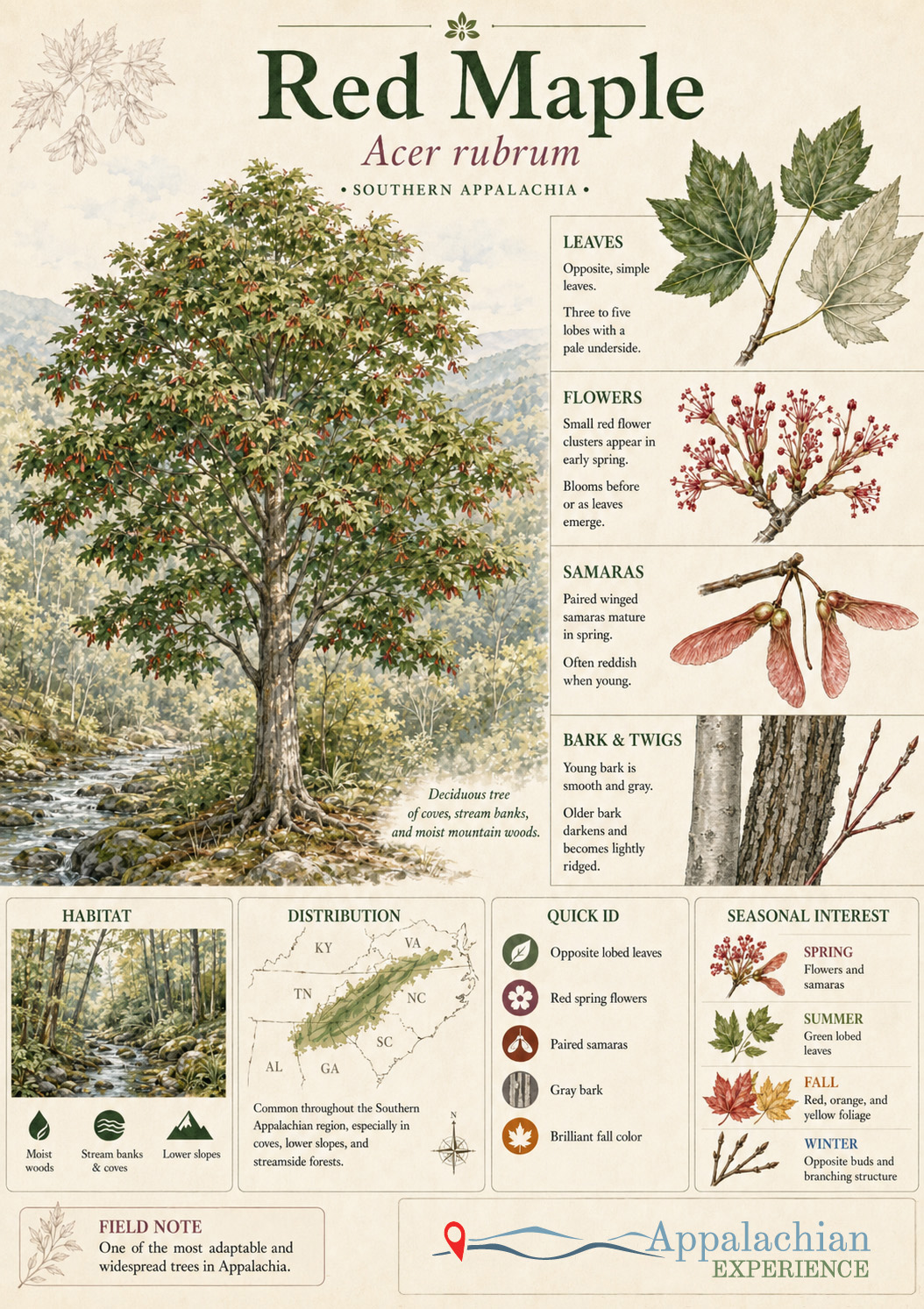
Red maple is one of the trees most people see often without always naming it. In Southern Appalachia, it shows up in coves, roadside edges, creek bottoms, old fields, and dry upland woods. Its strength is adaptability. It can grow where soils are wet, where slopes are thin and rocky, and where disturbance has opened light into the forest.
Quick Facts
Common Name
Scientific Name
Family
Plant Type
Typical Size
Flowers / Pollen Cones
Fruit / Seed /Seed Cones
Common Habitat
Caution
Red Maple
Acer rubrum
Sapindaceae, the soapberry family
Deciduous hardwood tree
Often 40 to 70 feet tall, taller on good sites
Small red to reddish flowers in very early spring
Paired winged samaras that mature in spring
Wet woods, stream edges, coves, old fields, dry ridges, roadsides, and mixed hardwood forests
No major public safety caution, though weak limbs can be an issue in older landscape trees
Where it Grows
Across Southern Appalachia, red maple grows from low valleys into mountain forests. It is common along roads and trails because it responds quickly to openings. In wetter coves it may grow with yellow-poplar, sweetgum, birches, and hemlock. On drier slopes it often mixes with oaks, hickories, sourwood, and pines.
How to Identify It
Red maple leaves usually have three to five lobes with toothed edges. The leaf shape is variable, so look for the whole pattern: reddish spring flowers, red or green twigs, paired winged seeds, gray bark on older trees, and red to orange fall color. Young bark is smooth and gray. Older bark becomes darker and broken into long plates.
Importance to the Appalchia Ecosystem
Red maple is a connector species. It feeds early-season pollinators with flowers before many canopy trees leaf out. Its seeds feed birds and small mammals, and its foliage supports insects that feed songbirds. Because it responds strongly to disturbance, it often fills gaps created by storms, cutting, fire exclusion, or old-field succession.
More trees...
Northern Appalachia
Southern Appalachia
Human Uses
Red maple is planted for shade and fall color. Its wood is used for furniture, pallets, veneer, fuel, and pulp, though it is softer than sugar maple. It can be tapped for sap, but it usually has lower sugar content than sugar maple and is less central to maple syrup production.
Interesting Facts
It is one of the widest-ranging eastern North American trees.
It flowers before leaf-out, which makes its red haze visible in late winter or early spring.
It tolerates a wider range of moisture conditions than many hardwoods.
Look-Alikes
Red maple can be confused with sugar maple and silver maple. Sugar maple usually has smoother leaf edges and U-shaped spaces between lobes. Silver maple leaves are more deeply cut, with a paler underside. Red maple’s spring samaras and red twigs help separate it.
Cautions and Common Problems
Red maple can develop weak branch unions in landscape settings if poorly pruned. In forest settings, defects are common on poor sites. Horses can be poisoned by eating wilted red maple leaves, so horse owners should be cautious with fallen branches and storm debris.
Seasonal Interest
Spring shows red flowers and winged seeds. Summer gives a medium-green canopy. Fall brings red, orange, or yellow color. Winter identification relies on red twigs, opposite buds, and older bark texture.
In the Appalachian Landscape
Red maple marks transition. It is a tree of wet pockets, dry ridges, cutover woods, cabin roads, and town edges. Its color is often one of the first and last signals of the hardwood season in Southern Appalachia.
Sources and Further Reading
- U.S. Forest Service Silvics of North America, Red Maple. https://research.fs.usda.gov/silvics/red-maple
- U.S. Forest Service FEIS, Acer rubrum. https://www.fs.usda.gov/database/feis/plants/tree/acerub/all.html
Last reviewed: 2026-10-07
Northern Appalachian Trees
Southern Appalachian Trees
Start your journey today at Appalachian Experience—where adventure meets tradition.
Get the Appalachian Experience Newsletter
Unlock the wonders of the Appalachian Mountains! Subscribe to our newsletter for the latest updates on attractions, events, and hidden gems. Follow us on social media to stay inspired by the beauty and adventure that awaits. Join our community today!