
Mountain Laurel
Kalmia latifolia
Introduction
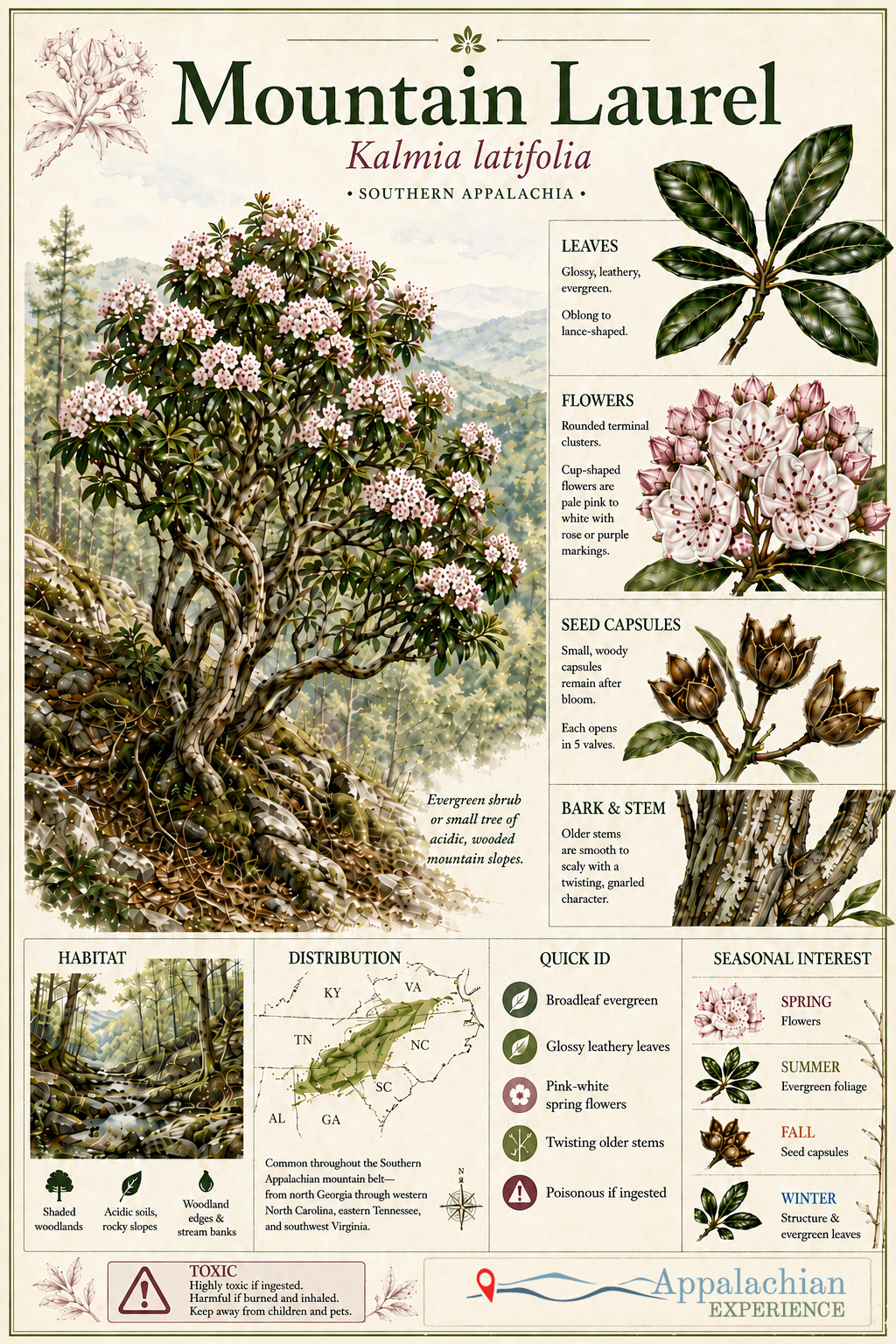
Mountain laurel gives Southern Appalachia one of its most recognizable spring scenes. It does not stand over the forest canopy like tulip poplar or white oak. It works closer to eye level, filling slopes and trail edges with glossy leaves, crooked stems, and clusters of pale flowers set against dark evergreen foliage. Even outside bloom season, it holds its place in the mountain woods. The leaves stay green through winter, and older stems twist into woody forms that can look more like small trees than shrubs.
Quick Facts
Common Name
Scientific Name
Family
Plant Type
Typical Size
Flowers / Pollen Cones
Fruit / Seed /Seed Cones
Common Habitat
Caution
Mountain Laurel
Kalmia latifolia
Ericaceae, the heath family
Broadleaf evergreen shrub or small tree
Usually 6 to 20 feet tall, with older mountain plants sometimes taking on a small-tree form
White, pale pink, or rose-colored flower clusters in late spring to early summer
Small dry capsules that split open when mature
Acidic woods, shaded slopes, stream banks, rocky ridges, mountain valleys, and woodland edges
Poisonous if ingested; keep people and livestock from browsing it
Where it Grows
In Southern Appalachia, mountain laurel is common on acidic soils from north Georgia through western North Carolina, east Tennessee, southwest Virginia, and neighboring highlands. It favors well-drained slopes and shaded woodland edges, but it can also appear on dry ridges and along streams. Where conditions suit it, it forms dense thickets that change the feel of the woods.
How to Identify It
Look first for a dense evergreen plant with smooth, glossy leaves and irregular woody stems. In bloom, the rounded clusters of cup-shaped flowers are the best clue. The flowers may be white, pale pink, or rose with darker markings inside. Older stems are often reddish-brown to gray-brown and cracked or crooked. After flowering, small dry seed capsules remain as a useful late-season marker.
Importance to the Appalchia Ecosystem
Mountain laurel shapes the understory. Its evergreen leaves provide year-round cover, its flowers draw bees and other pollinators, and its roots help hold soil on slopes. Dense growth can also reduce light at ground level and limit tree seedlings. That mix of shelter, shade, and competition makes mountain laurel an active part of the forest structure.
More trees...
Northern Appalachia
Southern Appalachia
Human Uses
Mountain laurel is widely planted in woodland gardens and mountain landscapes. It works best in acidic, moist, well-drained soil with a cool root zone. Its twisted older branches have also been used in rustic furniture and decorative woodwork. It should not be treated as a wild edible or home remedy plant.
Interesting Facts
Its flowers use a spring-loaded pollen system that snaps pollen onto visiting insects.
It is evergreen, but it is not a conifer.
It belongs to the same family as rhododendrons, azaleas, blueberries, and sourwood.
Look-Alikes
Mountain laurel is often confused with rhododendron. Mountain laurel leaves are usually smaller and more oval, while many rhododendrons have broader, larger leaves. Its cup-shaped flowers also differ from the larger open clusters of rhododendron. Cherry laurel has glossy evergreen leaves too, but its flowers and fruit are different.
Cautions and Common Problems
The main safety issue is toxicity. All plant parts should be treated as poisonous. Leaf spots, blights, borers, scale, lace bugs, and whiteflies may affect stressed plants. On home sites, avoid planting it tight against a house because the plant can burn readily.
Seasonal Interest
Spring brings the flowers. Summer shows the glossy evergreen leaves and forming capsules. Fall leaves mountain laurel green beneath the changing hardwoods. Winter exposes its twisting stems and dark foliage when the canopy opens.
In the Appalachian Landscape
Mountain laurel is part of the visual experience of Southern Appalachian woods. It arches over slopes, frames creek banks, and gives shaded roadsides a layered evergreen edge. People who spend time in the mountain landscape often remember it as pale bloom, dark foliage, and crooked stems woven through the understory.
Sources and Further Reading
- U.S. Forest Service Fire Effects Information System, Kalmia latifolia. https://www.fs.usda.gov/database/feis/plants/shrub/kallat/all.html
- NC State Extension Plant Toolbox, Kalmia latifolia. https://plants.ces.ncsu.edu/plants/kalmia-latifolia/
- Clemson Cooperative Extension, Mountain Laurel. https://hgic.clemson.edu/mountain-laurel/
- Arnold Arboretum, Mountain Laurels Fling Pollen. https://arboretum.harvard.edu/stories/mountain-laurels-fling-pollen/
Last reviewed: 2026-10-07
Northern Appalachian Trees
Southern Appalachian Trees
Start your journey today at Appalachian Experience—where adventure meets tradition.
Get the Appalachian Experience Newsletter
Unlock the wonders of the Appalachian Mountains! Subscribe to our newsletter for the latest updates on attractions, events, and hidden gems. Follow us on social media to stay inspired by the beauty and adventure that awaits. Join our community today!