
Black Birch/Sweet Birch
Betula lenta
Introduction
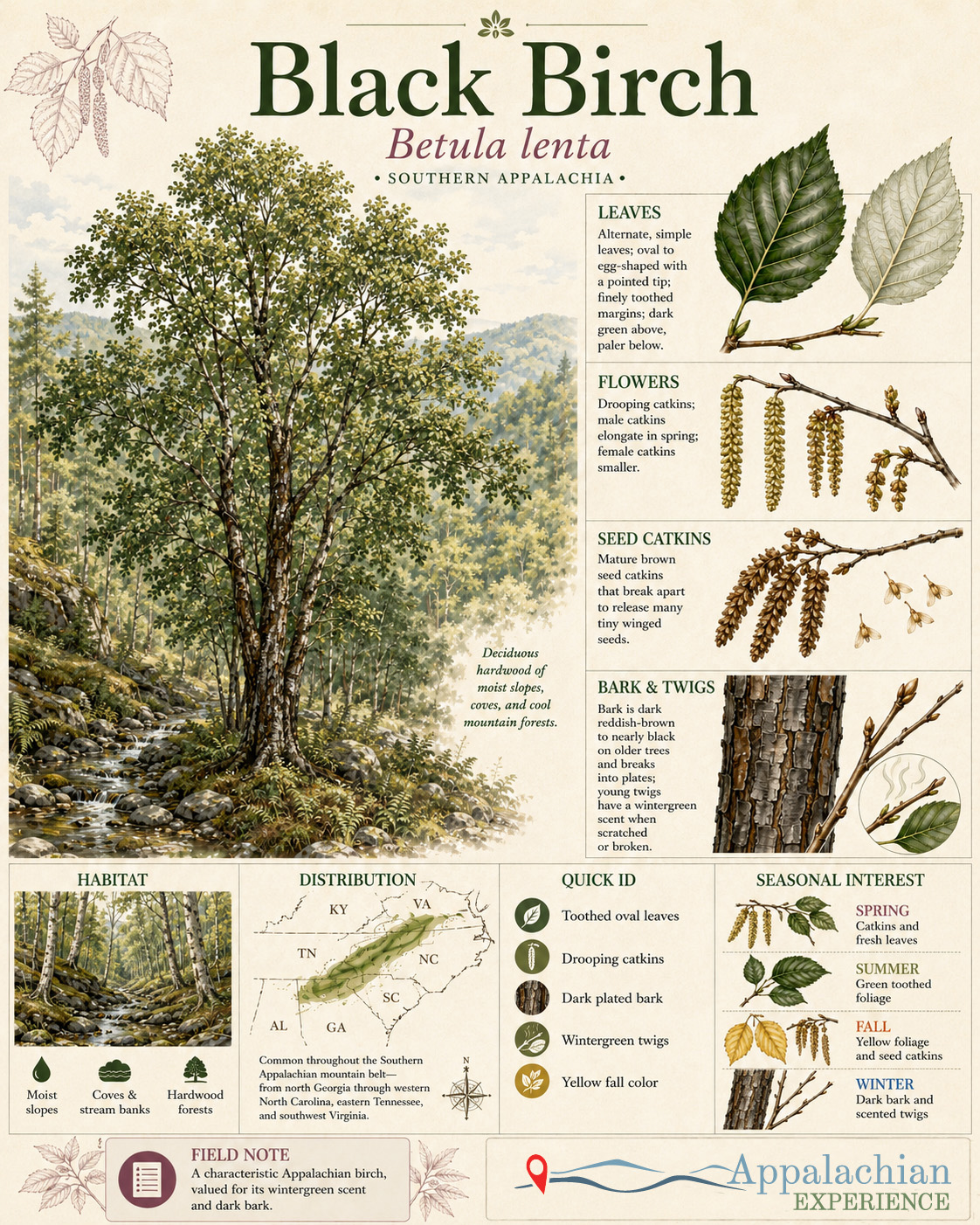
Black birch, also called sweet birch, is one of the sensory trees of Appalachia. Break a small twig, and the wintergreen scent is immediate. In the forest, it often grows on cool slopes and rocky sites where its dark bark and fine leaves blend with hemlock, maple, and oak.
Quick Facts
Common Name
Scientific Name
Family
Plant Type
Typical Size
Flowers / Pollen Cones
Fruit / Seed /Seed Cones
Common Habitat
Caution
Black Birch/Sweet Birch
Betula lenta
Betulaceae, the birch family
Deciduous hardwood tree
Usually 40 to 70 feet tall
Catkins in spring
Small winged seeds in upright catkin-like structures
Cool slopes, ravines, rocky woods, and mixed hardwood forests
No major public safety caution; avoid stripping bark from living trees
Where it Grows
In Southern Appalachia, black birch is common in cool coves, rocky slopes, and mid- to high-elevation hardwood forests. It reaches strong development on moist protected slopes.
How to Identify It
Look for dark, smooth young bark that becomes broken with age, oval toothed leaves, slender twigs with a strong wintergreen scent, and catkins. The bark does not peel in large white sheets like paper birch.
Importance to the Appalchia Ecosystem
Black birch helps occupy openings and rocky sites. Its seeds feed birds and small mammals, and its leaves support many insects. It is part of the cool hardwood mix that links Southern Appalachian forests to northern hardwood communities.
More trees...
Northern Appalachia
Southern Appalachia
Human Uses
The wood is used for furniture, cabinets, veneer, boxes, interior finish, and fuel. Historically, bark and twigs were used as a source of wintergreen flavoring, though modern commercial wintergreen is usually synthetic.
Interesting Facts
Crushed twigs smell like wintergreen.
Its wood darkens in air and can resemble mahogany.
It is closely related to yellow birch.
Look-Alikes
Black birch can be confused with yellow birch or cherry. The wintergreen scent is the best quick clue. Yellow birch has bronze peeling bark, while cherry bark has horizontal lenticels and a bitter almond scent when scratched.
Cautions and Common Problems
Young trees have thin bark and can be damaged by fire. Leaf diseases and cankers may occur. Bark stripping harms living trees.
Seasonal Interest
Spring brings catkins and new leaves. Summer shows glossy green foliage. Fall color is yellow. Winter identification relies on dark bark, slender twigs, and wintergreen scent.
In the Appalachian Landscape
Black birch rewards close attention. It is not the loudest tree in the forest, but a broken twig turns identification into memory. In Appalachian woods, scent can be as useful as sight.
Sources and Further Reading
- U.S. Forest Service Silvics of North America, Sweet Birch. https://research.fs.usda.gov/silvics/sweet-birch
Last reviewed: 2026-10-07
Northern Appalachian Trees
Southern Appalachian Trees
Start your journey today at Appalachian Experience—where adventure meets tradition.
Get the Appalachian Experience Newsletter
Unlock the wonders of the Appalachian Mountains! Subscribe to our newsletter for the latest updates on attractions, events, and hidden gems. Follow us on social media to stay inspired by the beauty and adventure that awaits. Join our community today!