
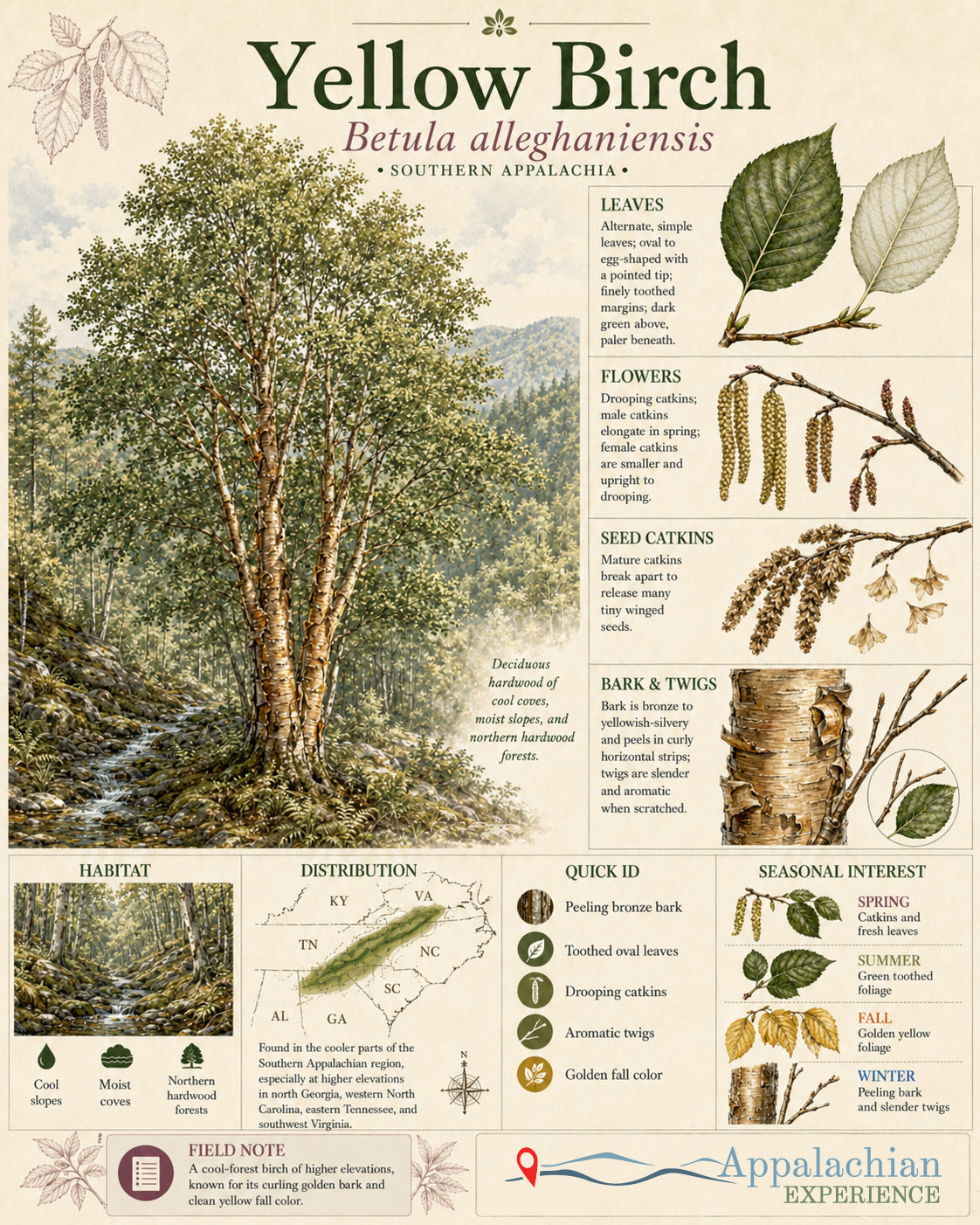
Yellow Birch
Betula alleghaniensis
Introduction
Yellow birch is a cool-air tree in Southern Appalachia. Its bronze-yellow bark catches light in ravines and high coves, and its roots often grip mossy rocks, old logs, and steep slopes. Where yellow birch appears, the forest usually feels cooler and wetter.
Quick Facts
Common Name
Scientific Name
Family
Plant Type
Typical Size
Flowers / Pollen Cones
Fruit / Seed /Seed Cones
Common Habitat
Caution
Yellow Birch
Betula alleghaniensis
Betulaceae, the birch family
Deciduous hardwood tree
Often 50 to 80 feet tall
Catkins in spring
Small winged seeds in cone-like structures
Cool coves, high-elevation hardwoods, ravines, stream edges, and moist slopes
No major public safety caution; avoid damaging bark and roots
Where it Grows
In Southern Appalachia, yellow birch is tied to high elevations, cool coves, ravines, and moist northern slopes. It commonly grows with sugar maple, beech, red spruce, eastern hemlock, black birch, and basswood.
How to Identify It
Look for peeling bronze to yellowish bark, oval toothed leaves, catkins, and twigs with a mild wintergreen scent. Mature trees often have ragged peeling bark and strong roots around rocks or nurse logs.
Importance to the Appalchia Ecosystem
Yellow birch contributes to moist northern hardwood and spruce-hardwood forests. Its seeds and buds feed wildlife, and its presence supports mossy, shaded habitats. It is also part of the transition zone between southern hardwood forests and northern mountain forests.
More trees...
Northern Appalachia
Southern Appalachia
Human Uses
Yellow birch wood is used for furniture, veneer, flooring, cabinets, and interior finish. Its bark and twigs have aromatic compounds, but the tree is best appreciated as a forest and identification species.
Interesting Facts
Bronze peeling bark is the best field mark.
It often grows from nurse logs in cool forests.
It is more northern in character than many Southern Appalachian hardwoods.
Look-Alikes
Yellow birch can be confused with black birch. Yellow birch has more bronze, peeling bark; black birch usually has darker bark and stronger wintergreen scent. Paper birch has bright white bark and is more northern.
Cautions and Common Problems
Thin bark and shallow roots make young trees vulnerable to fire and soil disturbance. Climate warming may pressure populations at lower southern elevations.
Seasonal Interest
Spring brings catkins. Summer shows full green leaves. Fall color is yellow. Winter shows peeling bark and branching form against dark conifers and bare hardwoods.
In the Appalachian Landscape
Yellow birch gives high Southern Appalachian woods a northern feeling. Its bark, mossy roots, and cool-slope habitat make it one of the trees that changes the mood of the forest with elevation.
Sources and Further Reading
- U.S. Forest Service Silvics of North America, Yellow Birch. https://research.fs.usda.gov/silvics/yellow-birch
Last reviewed: 2026-10-07
Northern Appalachian Trees
Southern Appalachian Trees
Start your journey today at Appalachian Experience—where adventure meets tradition.
Get the Appalachian Experience Newsletter
Unlock the wonders of the Appalachian Mountains! Subscribe to our newsletter for the latest updates on attractions, events, and hidden gems. Follow us on social media to stay inspired by the beauty and adventure that awaits. Join our community today!