
Red Spruce
Picea rubens
Introduction
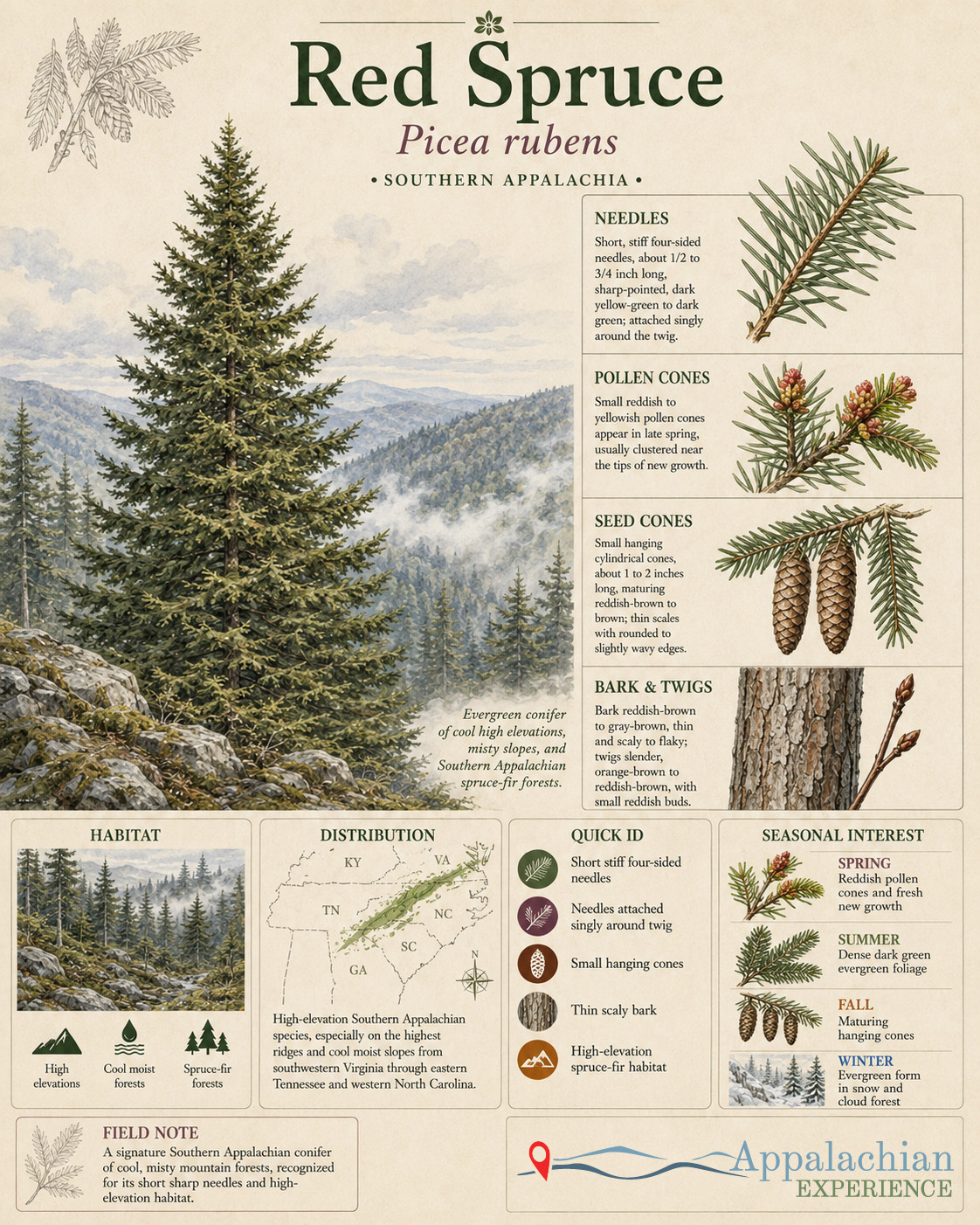
Red spruce is a high mountain tree in Southern Appalachia. It belongs to cold summits, fog, thin soils, and wind-shaped forests. Where red spruce appears, the mountains feel less southern and more boreal.
Quick Facts
Common Name
Scientific Name
Family
Plant Type
Typical Size
Flowers / Pollen Cones
Fruit / Seed /Seed Cones
Common Habitat
Caution
Red Spruce
Picea rubens
Pinaceae, the pine family
Evergreen conifer
Often 60 to 90 feet tall in favorable forests
Pollen cones and seed cones
Small hanging cones
High-elevation forests, cool ridges, spruce-fir zones, and northern hardwood transitions
No major public safety caution; high-elevation forests are sensitive habitats
Where it Grows
In Southern Appalachia, red spruce is concentrated at high elevations and cool mountain ridges, often with Fraser fir, yellow birch, mountain ash, beech, and other northern hardwood associates.
How to Identify It
Look for short, sharp, four-sided needles attached singly around the twig, small hanging cones, and scaly reddish-brown bark. Needles roll between the fingers, unlike flat hemlock needles.
Importance to the Appalchia Ecosystem
Red spruce helps form high-elevation spruce-fir and spruce-hardwood forests. These forests provide habitat for specialized plants and animals, hold moisture, and influence headwater streams.
More trees...
Northern Appalachia
Southern Appalachia
Human Uses
The wood has been used for pulp, lumber, sounding boards, and other products. In Southern Appalachia today, red spruce is also tied to restoration work and high-elevation conservation.
Interesting Facts
It is one of the trees that gives Southern Appalachian summits a northern forest character.
Its needles are sharp and four-sided.
Spruce-fir forests in the southern mountains are limited and ecologically sensitive.
Look-Alikes
Red spruce can be confused with Fraser fir and hemlock. Spruce needles are sharp and four-sided. Fir needles are flatter and cones stand upright. Hemlock needles are flatter and softer with small hanging cones.
Cautions and Common Problems
Past logging, fire, acid deposition, climate stress, and habitat fragmentation have affected red spruce forests. High-elevation soils and plants are easily damaged by trampling.
Seasonal Interest
Spring brings new pale growth. Summer keeps the canopy dark and cool. Fall brings contrast with hardwood color. Winter often shows spruce against fog, ice, and snow.
In the Appalachian Landscape
Red spruce marks the upper mountain world. It changes the forest from broadleaf shade to dark spire, moss, and cloud.
Sources and Further Reading
- U.S. Forest Service Silvics of North America, Red Spruce. https://research.fs.usda.gov/silvics/red-spruce
Last reviewed: 2026-10-07
Northern Appalachian Trees
Southern Appalachian Trees
Start your journey today at Appalachian Experience—where adventure meets tradition.
Get the Appalachian Experience Newsletter
Unlock the wonders of the Appalachian Mountains! Subscribe to our newsletter for the latest updates on attractions, events, and hidden gems. Follow us on social media to stay inspired by the beauty and adventure that awaits. Join our community today!