
Fraser Fir
Abies fraseri
Introduction
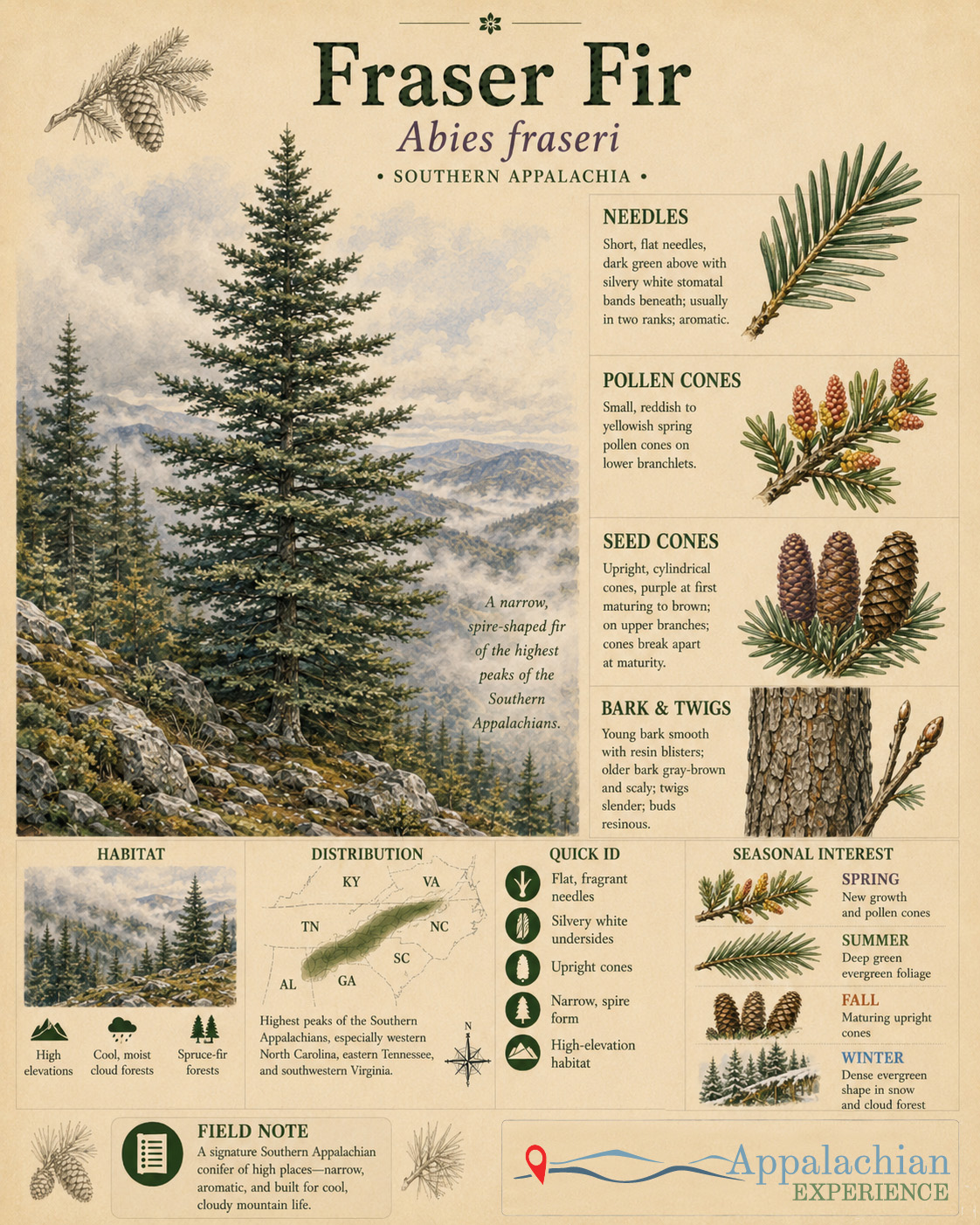
Fraser fir is one of the most geographically tied trees in the Appalachian series. It belongs to the highest Southern Appalachian mountains, where it grows with red spruce in cold, wet, windy forests. Its narrow spire and soft evergreen foliage are part of the summit experience.
Quick Facts
Common Name
Scientific Name
Family
Plant Type
Typical Size
Flowers / Pollen Cones
Fruit / Seed /Seed Cones
Common Habitat
Caution
Fraser Fir
Abies fraseri
Pinaceae, the pine family
Evergreen conifer
Often 30 to 50 feet tall, taller in protected sites
Pollen cones and upright seed cones
Upright cones that break apart on the branch
High-elevation Southern Appalachian spruce-fir forests
Sensitive high-elevation species; balsam woolly adelgid has caused major mortality
Where it Grows
Fraser fir is restricted to high elevations in the Southern Appalachians. It grows with red spruce on summits and upper slopes in North Carolina, Tennessee, and Virginia.
How to Identify It
Look for a narrow conical evergreen, flat needles with pale lines beneath, smooth gray bark with resin blisters on young trees, and upright cones. Unlike spruce cones, fir cones stand upright and break apart on the branch rather than falling whole.
Importance to the Appalchia Ecosystem
Fraser fir helps define spruce-fir forest, a rare high-elevation ecosystem with cool, wet conditions and specialized wildlife. The tree provides evergreen cover and helps shape cloud forest habitat.
More trees...
Northern Appalachia
Southern Appalachia
Human Uses
Fraser fir is widely grown as a Christmas tree, especially in North Carolina. Wild high-elevation populations, however, are conservation concerns and should not be treated as harvest sources.
Interesting Facts
It is native only to a limited portion of the Southern Appalachians.
Its upright cones separate it from spruce and hemlock.
Christmas tree farms grow Fraser fir far beyond its wild mountain settings.
Look-Alikes
Fraser fir can be confused with balsam fir, red spruce, and hemlock. Fraser fir has flat needles and upright cones; red spruce has sharp four-sided needles and hanging cones. Balsam fir is the northern counterpart.
Cautions and Common Problems
Balsam woolly adelgid has killed many mature Fraser firs. Climate change, storm exposure, and trampling in high-elevation habitat are also concerns.
Seasonal Interest
Spring brings pale new growth. Summer keeps the summit forest dark green. Fall contrasts fir with mountain hardwoods below. Winter often coats the trees in rime, snow, and wind.
In the Appalachian Landscape
Fraser fir is part of the high Appalachian edge, where forest meets weather. It gives the southern mountains a summit character that feels older, colder, and more exposed than the valleys below.
Sources and Further Reading
- U.S. Forest Service Silvics of North America, Fraser Fir. https://research.fs.usda.gov/silvics/fraser-fir
Last reviewed: 2026-10-07
Northern Appalachian Trees
Southern Appalachian Trees
Start your journey today at Appalachian Experience—where adventure meets tradition.
Get the Appalachian Experience Newsletter
Unlock the wonders of the Appalachian Mountains! Subscribe to our newsletter for the latest updates on attractions, events, and hidden gems. Follow us on social media to stay inspired by the beauty and adventure that awaits. Join our community today!