
Flowering Dogwood
Cornus florida
Introduction
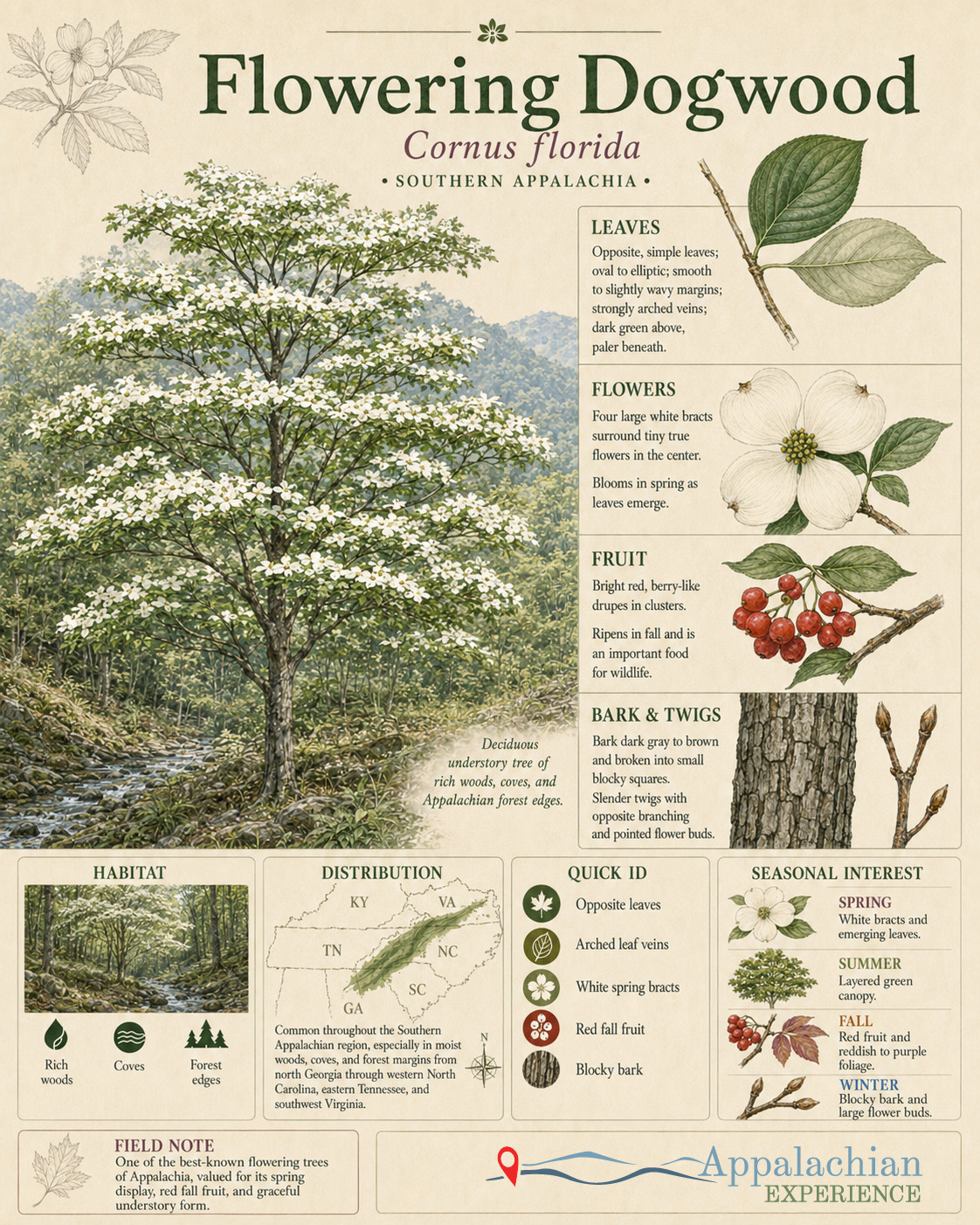
Flowering dogwood is one of the best-known understory trees in Southern Appalachia. Its spring display is not made of petals in the usual sense, but of showy bracts around small flowers. In the forest, it lights up beneath the taller hardwoods before the canopy closes.
Quick Facts
Common Name
Scientific Name
Family
Plant Type
Typical Size
Flowers / Pollen Cones
Fruit / Seed /Seed Cones
Common Habitat
Caution
Flowering Dogwood
Cornus florida
Cornaceae, the dogwood family
Deciduous understory tree
Usually 15 to 40 feet tall
Small true flowers surrounded by showy white or pink bracts in spring
Red drupes in fall
Understory woods, edges, slopes, yards, and mixed hardwood forests
Fruit is not for human eating; dogwood anthracnose and borers can be problems
Where it Grows
In Southern Appalachia, flowering dogwood grows in understory woods, woodland edges, slopes, and yards. It often appears with oaks, hickories, red maple, sourwood, black cherry, and tulip poplar.
How to Identify It
Look for opposite leaves with arcing veins, blocky gray bark on older trees, red fruits in fall, and spring bracts that look like four white or pink petals. The branching pattern is often layered and horizontal.
Importance to the Appalchia Ecosystem
Dogwood fruits feed birds and mammals, and the spring flowers support insects. As an understory tree, it adds a middle layer between ground plants and canopy trees.
More trees...
Northern Appalachia
Southern Appalachia
Human Uses
Flowering dogwood is widely planted as an ornamental native tree. Its hard wood has been used for small items such as tool handles, shuttles, and mallets, but today its main use is ornamental and ecological.
Interesting Facts
The showy white parts are bracts, not petals.
Opposite leaves and arcing veins help identify it after bloom.
Its red fruits are valuable to wildlife.
Look-Alikes
Flowering dogwood can be confused with Kousa dogwood, a nonnative ornamental. Kousa blooms later and has pointed bracts and raspberry-like fruit. Native dogwood fruits are red drupes in clusters.
Cautions and Common Problems
Dogwood anthracnose, powdery mildew, borers, drought, and mower injury can affect trees. Fruit should not be treated as human food.
Seasonal Interest
Spring brings bracts and flowers. Summer shows layered green leaves. Fall brings red fruits and red-purple foliage. Winter shows blocky bark and opposite buds.
In the Appalachian Landscape
Flowering dogwood is part of the understory memory of Appalachia. It brings spring light beneath the canopy and red fruit into the fall woods.
Sources and Further Reading
- U.S. Forest Service Silvics of North America, Flowering Dogwood. https://research.fs.usda.gov/silvics/flowering-dogwood
Last reviewed: 2026-10-07
Northern Appalachian Trees
Southern Appalachian Trees
Start your journey today at Appalachian Experience—where adventure meets tradition.
Get the Appalachian Experience Newsletter
Unlock the wonders of the Appalachian Mountains! Subscribe to our newsletter for the latest updates on attractions, events, and hidden gems. Follow us on social media to stay inspired by the beauty and adventure that awaits. Join our community today!