
Sourwood
Oxydendrum arboreum
Introduction
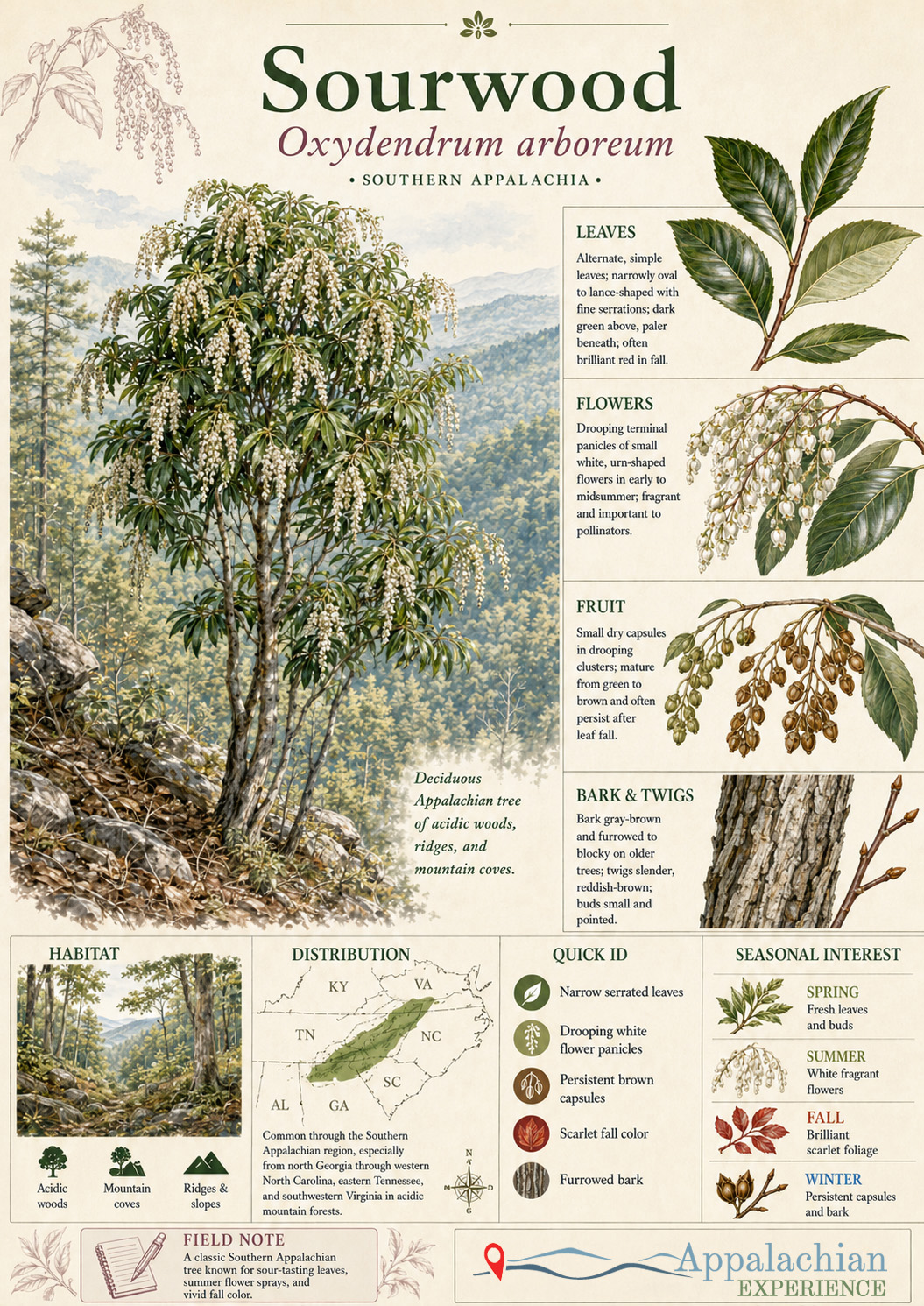
Sourwood is one of the most Appalachian-feeling small trees. It blooms in midsummer when many other trees are finished flowering, and its white hanging flower clusters look almost like lily-of-the-valley. In fall, the leaves often turn strong red, making it valuable in both forest and yard.
Quick Facts
Common Name
Scientific Name
Family
Plant Type
Typical Size
Flowers / Pollen Cones
Fruit / Seed /Seed Cones
Common Habitat
Caution
Sourwood
Oxydendrum arboreum
Ericaceae, the heath family
Deciduous small to medium tree
Usually 20 to 50 feet tall, occasionally taller
White bell-shaped flowers in drooping clusters in summer
Small capsules with tiny seeds
Dry slopes, ridges, oak-hickory woods, pine-oak woods, and forest edges
No major public safety caution; bees strongly visit flowers
Where it Grows
In Southern Appalachia, sourwood is common on dry slopes, ridges, open oak woods, pine-oak woods, and forest edges. It often grows with chestnut oak, scarlet oak, white oak, Virginia pine, hickories, and mountain laurel.
How to Identify It
Look for finely toothed leaves with a sour taste if nibbled, drooping clusters of white bell-shaped flowers, small capsules, and often leaning or irregular form. The leaves are simple, alternate, and often glossy.
Importance to the Appalchia Ecosystem
Sourwood flowers are a valuable nectar source for bees, and sourwood honey is well known in parts of the Appalachians. The tree also adds understory structure and fall color to dry upland forests.
More trees...
Northern Appalachia
Southern Appalachia
Human Uses
Sourwood is planted as an ornamental for flowers and fall color. Its wood is not a major timber product, though it has been used locally for fuel and handles. Its honey association is its best-known human use.
Interesting Facts
It flowers later than many Appalachian trees.
Sourwood honey has a strong regional reputation.
It belongs to the same family as mountain laurel, rhododendron, and blueberries.
Look-Alikes
Sourwood can be confused with blackgum or young persimmon by beginners. The drooping white flower clusters, sour leaves, and fine teeth help identify it.
Cautions and Common Problems
Sourwood generally has few serious disease problems, though leaf spots and twig insects may occur. It can be difficult to transplant and prefers acidic, well-drained soil.
Seasonal Interest
Summer brings the flowers. Fall brings red foliage. Winter shows slender capsules and a leaning, irregular form. Spring leaves emerge fresh and narrow.
In the Appalachian Landscape
Sourwood ties forest ecology to local taste. Its flowers feed bees, its honey carries a mountain identity, and its fall color brightens dry ridges and cabin roads.
Sources and Further Reading
- U.S. Forest Service Silvics of North America, Sourwood. https://research.fs.usda.gov/silvics/sourwood
Last reviewed: 2026-10-07
Northern Appalachian Trees
Southern Appalachian Trees
Start your journey today at Appalachian Experience—where adventure meets tradition.
Get the Appalachian Experience Newsletter
Unlock the wonders of the Appalachian Mountains! Subscribe to our newsletter for the latest updates on attractions, events, and hidden gems. Follow us on social media to stay inspired by the beauty and adventure that awaits. Join our community today!