
Red Maple
Acer rubrum
Introduction
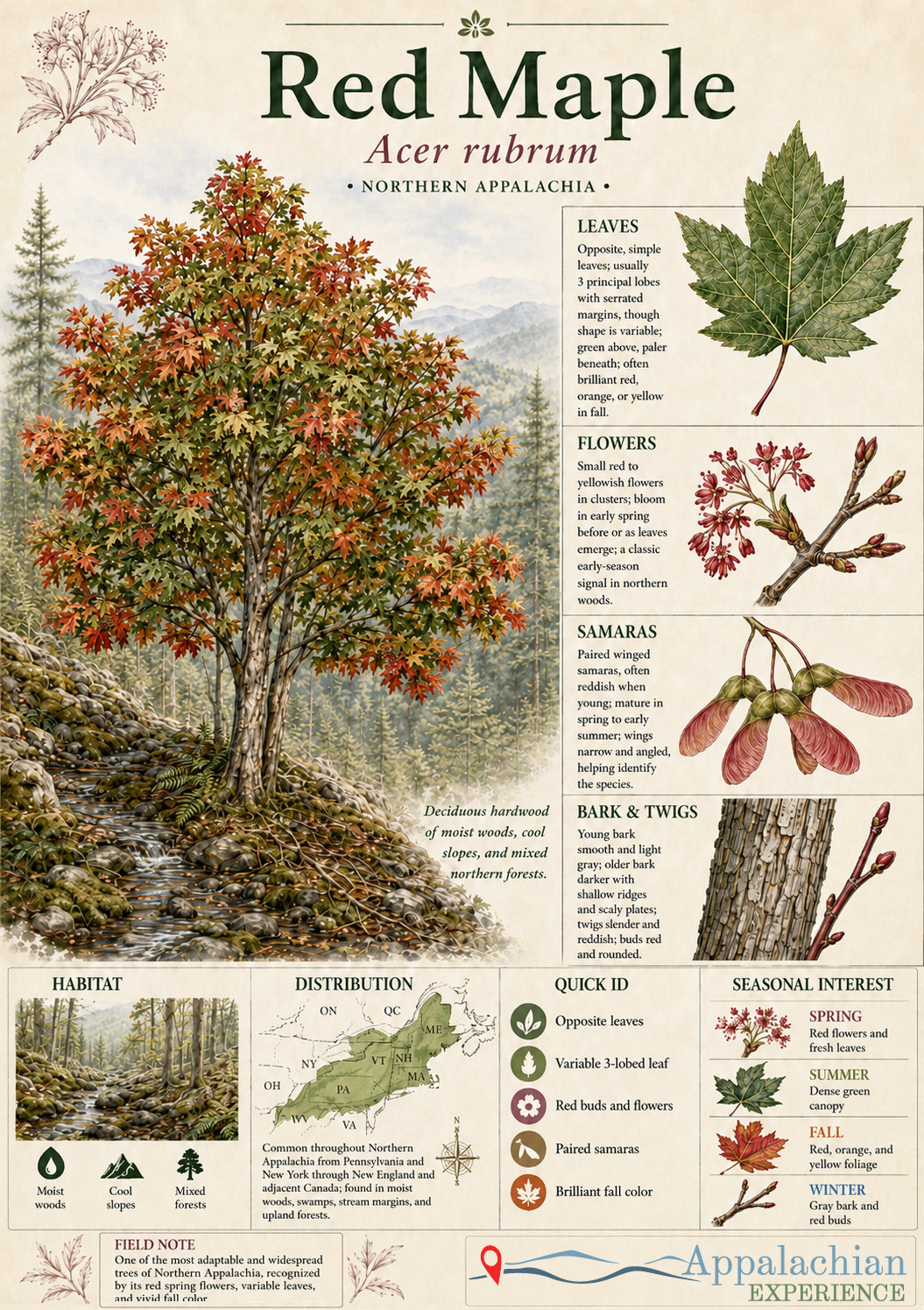
Red maple is everywhere in Northern Appalachia: wet lowlands, dry ridges, disturbed stands, town edges, and mixed woods. It is often one of the first trees to color the spring woods and one of the most noticeable trees in fall.
Quick Facts
Common Name
Scientific Name
Family
Plant Type
Typical Size
Flowers / Pollen Cones
Fruit / Seed /Seed Cones
Common Habitat
Caution
Red Maple
Acer rubrum
Sapindaceae, the soapberry family
Deciduous hardwood tree
Often 40 to 70 feet tall
Red to reddish flowers in very early spring
Paired winged samaras that mature in spring
Wet woods, swamps, uplands, disturbed forests, old fields, and road edges
Wilted leaves can poison horses; weak limb structure may be an issue in yards
Where it Grows
In Northern Appalachia, red maple grows in swamps, mixed hardwood stands, old fields, and upland forests. It commonly grows with sugar maple, beech, birches, hemlock, white pine, black cherry, and northern red oak.
How to Identify It
Look for opposite branching, red twigs, three- to five-lobed leaves with toothed edges, early red flowers, and spring samaras. Mature bark becomes gray and broken into plates.
Importance to the Appalchia Ecosystem
Red maple feeds early pollinators, produces seeds for birds and small mammals, and responds quickly to canopy gaps. It is one of the trees that fills disturbed forest space and adds structural variety.
More trees...
Northern Appalachia
Southern Appalachia
Human Uses
The wood is used as soft maple for furniture, pallets, pulp, fuel, and veneer. It is also widely planted as a shade and fall-color tree.
Interesting Facts
It has one of the broadest ranges of eastern North American trees.
It can grow on both wet and dry sites.
Its spring flowers often redden the woods before leaf-out.
Look-Alikes
Red maple can be confused with sugar maple and silver maple. Red maple has more toothed leaves than sugar maple and less deeply cut leaves than silver maple.
Cautions and Common Problems
Wilted leaves can be toxic to horses. In yards, poor branching can lead to storm breakage.
Seasonal Interest
Spring shows red flowers and samaras. Summer leaves are green. Fall can be red, orange, or yellow. Winter shows red twigs and opposite buds.
In the Appalachian Landscape
Red maple is a tree of change. It shows up in wet ground, cutover woods, roadside edges, and old fields, marking the places where the Appalachian forest keeps adjusting.
Sources and Further Reading
- U.S. Forest Service Silvics of North America, Red Maple. https://research.fs.usda.gov/silvics/red-maple
Last reviewed: 2026-10-07
Northern Appalachian Trees
Southern Appalachian Trees
Start your journey today at Appalachian Experience—where adventure meets tradition.
Get the Appalachian Experience Newsletter
Unlock the wonders of the Appalachian Mountains! Subscribe to our newsletter for the latest updates on attractions, events, and hidden gems. Follow us on social media to stay inspired by the beauty and adventure that awaits. Join our community today!