
Balsam Fir
Abies balsamea
Introduction
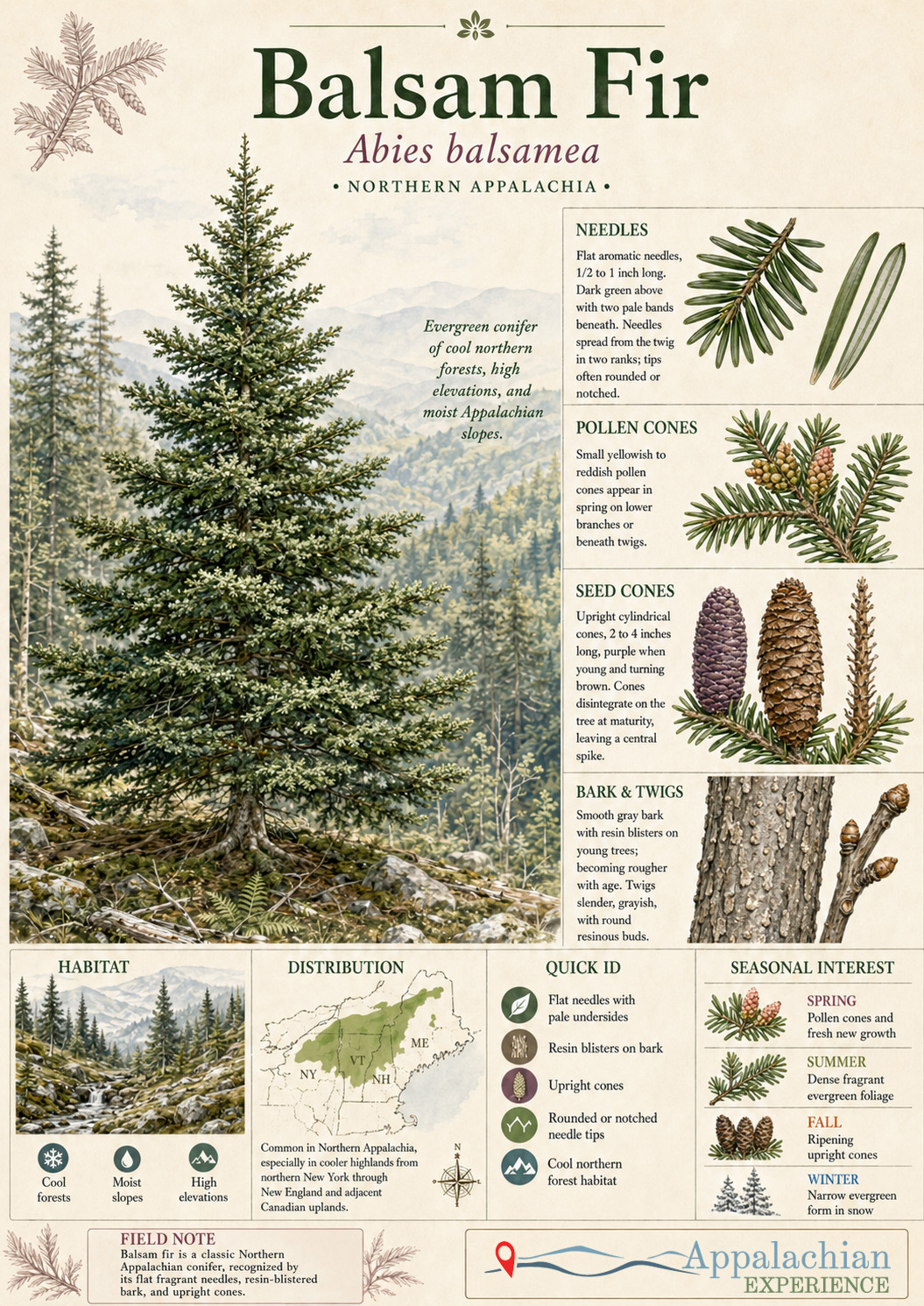
Balsam fir is the northern fir of Appalachian high country. It brings flat needles, resin blisters, a narrow crown, and the scent many people associate with cold forests and Christmas greenery.
Quick Facts
Common Name
Scientific Name
Family
Plant Type
Typical Size
Flowers / Pollen Cones
Fruit / Seed /Seed Cones
Common Habitat
Caution
Balsam Fir
Abies balsamea
Pinaceae, the pine family
Evergreen conifer
Often 40 to 60 feet tall
Pollen cones and upright seed cones
Upright cones that break apart on branches
Cold high-elevation forests, spruce-fir woods, bogs, and northern conifer stands
No major public safety caution; balsam woolly adelgid may affect trees
Where it Grows
In Northern Appalachia, balsam fir grows in cold, moist forests, high elevations, bog edges, and spruce-fir stands. It grows with red spruce, paper birch, yellow birch, mountain ash, and hemlock.
How to Identify It
Look for flat needles with pale lines beneath, smooth gray bark with resin blisters on young stems, and upright cones that disintegrate on the branch. The crown is often narrow and spire-like.
Importance to the Appalchia Ecosystem
Balsam fir provides evergreen cover and winter shelter. It helps form spruce-fir habitat and supports birds and mammals that use dense conifer cover.
More trees...
Northern Appalachia
Southern Appalachia
Human Uses
Balsam fir is used for Christmas trees, wreaths, pulpwood, and aromatic products. Resin from blisters has had traditional uses, though harvesting should be done with care and permission.
Interesting Facts
It is the northern counterpart to Southern Appalachia’s Fraser fir.
Its bark has resin blisters when young.
Its cones stand upright rather than hanging.
Look-Alikes
Balsam fir can be confused with Fraser fir, spruce, and hemlock. Fir needles are flat, spruce needles are sharp and four-sided, and hemlock cones are small and hanging.
Cautions and Common Problems
Balsam woolly adelgid, spruce budworm, windthrow, and root rot can affect trees. It is shallow-rooted and vulnerable to exposure.
Seasonal Interest
Spring brings soft new growth. Summer keeps the tree dark green. Fall contrasts fir with hardwood color. Winter shows its narrow evergreen form.
In the Appalachian Landscape
Balsam fir is part of the scent and shape of northern highlands. It gives the forest a cold evergreen character even in summer.
Sources and Further Reading
- U.S. Forest Service Silvics of North America, Balsam Fir. https://research.fs.usda.gov/silvics/balsam-fir
Last reviewed: 2026-10-07
Northern Appalachian Trees
Southern Appalachian Trees
Start your journey today at Appalachian Experience—where adventure meets tradition.
Get the Appalachian Experience Newsletter
Unlock the wonders of the Appalachian Mountains! Subscribe to our newsletter for the latest updates on attractions, events, and hidden gems. Follow us on social media to stay inspired by the beauty and adventure that awaits. Join our community today!