
American Basswood
Tilia americana
Introduction
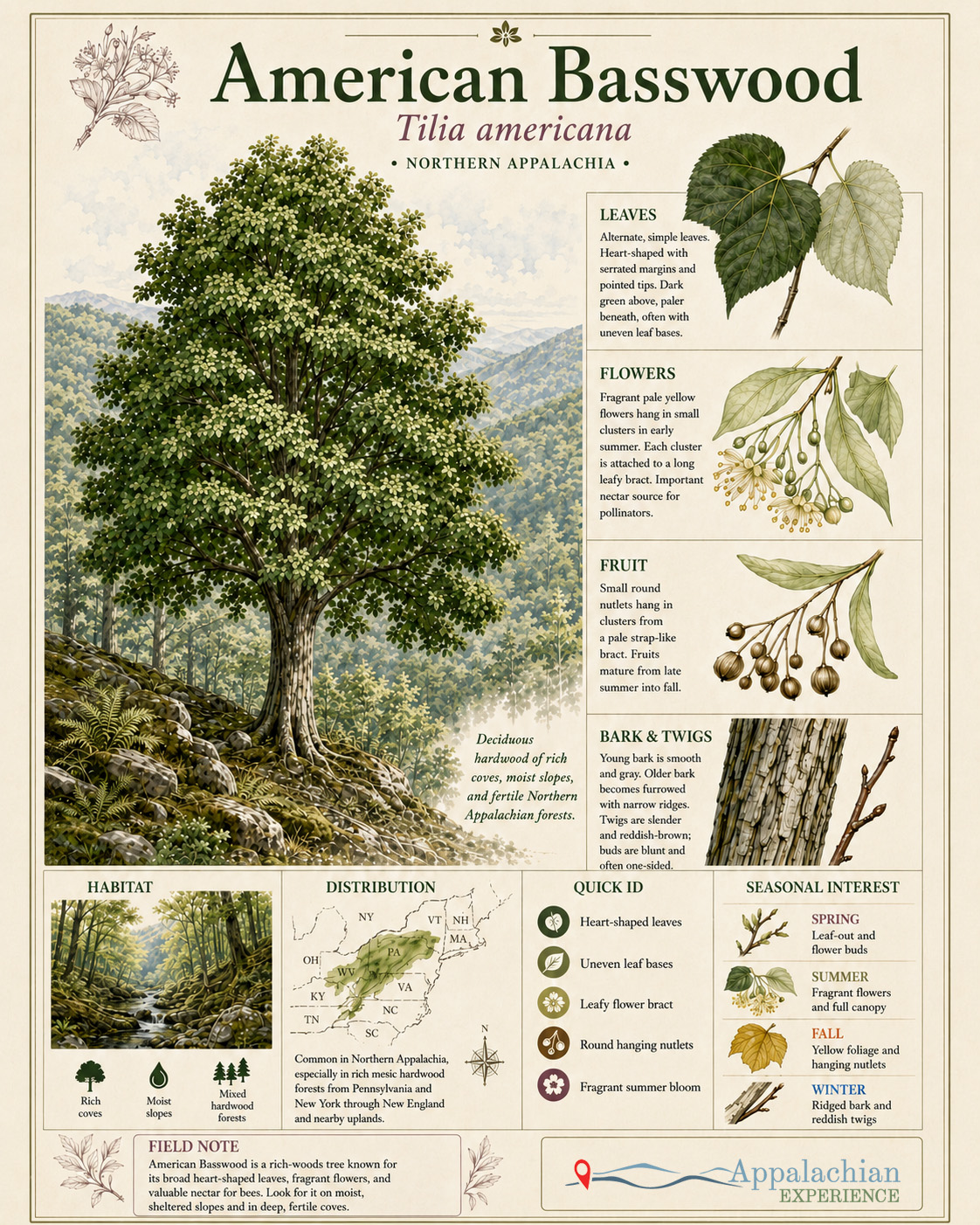
American basswood is a rich-site tree of Northern Appalachian woods. Its large heart-shaped leaves, fragrant flowers, and hanging bracts give it a softer look than the oaks and maples around it.
Quick Facts
Common Name
Scientific Name
Family
Plant Type
Typical Size
Flowers / Pollen Cones
Fruit / Seed /Seed Cones
Common Habitat
Caution
American Basswood
Tilia americana
Malvaceae, the mallow family
Deciduous hardwood tree
Often 60 to 100 feet tall
Fragrant pale yellow flowers in early summer
Small nutlets attached to a leaflike bract
Rich woods, coves, moist slopes, and northern hardwood forests
Flowers attract many bees; no major public safety caution
Where it Grows
In Northern Appalachia, basswood grows in rich, moist woods and coves with sugar maple, white ash, yellow birch, beech, and black cherry.
How to Identify It
Look for large heart-shaped leaves, uneven leaf bases, fragrant pale flowers, and small nutlets hanging from a narrow leaflike bract. Bark becomes gray and furrowed with age.
Importance to the Appalchia Ecosystem
Basswood flowers are important to bees and other pollinators. The tree adds broad leaves, rich litter, and canopy diversity to productive hardwood stands.
More trees...
Northern Appalachia
Southern Appalachia
Human Uses
The soft light wood is used for carving, boxes, crates, veneer, and lightweight products. The inner bark fibers have been used for cordage. The flowers are valued by beekeepers.
Interesting Facts
Its flowers are strongly attractive to bees.
The leaflike bract attached to the fruit cluster is a key feature.
Basswood is a favorite carving wood.
Look-Alikes
Basswood can be confused with young redbud or mulberry by leaf shape, but the flower bracts and nutlets are distinctive.
Cautions and Common Problems
Japanese beetles and other leaf feeders may damage foliage. Basswood can sprout from the base and form clumps.
Seasonal Interest
Early summer brings fragrant flowers. Summer shows large leaves. Fall color is yellow. Winter identification uses buds, bark, and sprout clusters.
In the Appalachian Landscape
Basswood adds richness to the northern Appalachian forest. Its flowers, broad leaves, and soft wood connect insects, soil, craft, and shade.
Sources and Further Reading
- U.S. Forest Service Silvics of North America, American Basswood. https://research.fs.usda.gov/silvics/american-basswood
Last reviewed: 2026-10-07
Northern Appalachian Trees
Southern Appalachian Trees
Start your journey today at Appalachian Experience—where adventure meets tradition.
Get the Appalachian Experience Newsletter
Unlock the wonders of the Appalachian Mountains! Subscribe to our newsletter for the latest updates on attractions, events, and hidden gems. Follow us on social media to stay inspired by the beauty and adventure that awaits. Join our community today!