
Striped Maple/Moosewood
Acer pensylvanicum
Introduction
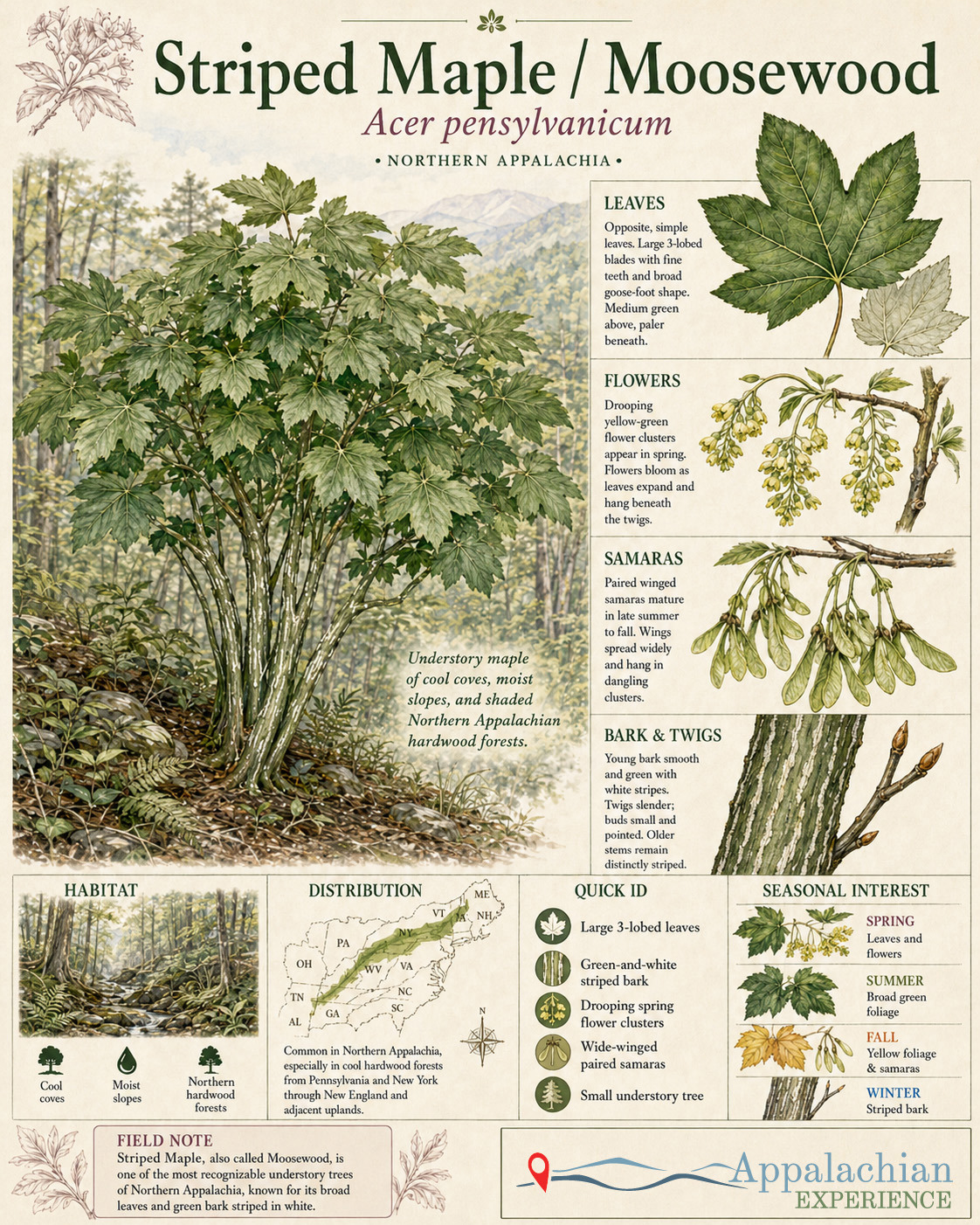
Striped maple, also called moosewood, is an understory tree that rewards people who look below the canopy. Its green bark with pale vertical stripes makes it one of the easiest small trees to recognize in Northern Appalachian woods.
Quick Facts
Common Name
Scientific Name
Family
Plant Type
Typical Size
Flowers / Pollen Cones
Fruit / Seed /Seed Cones
Common Habitat
Caution
Striped Maple/Moosewood
Acer pensylvanicum
Sapindaceae, the soapberry family
Deciduous small tree
Usually 15 to 30 feet tall
Dangling yellow-green flower clusters in spring
Paired samaras
Cool shaded understory, northern hardwoods, ravines, and moist slopes
No major public safety caution
Where it Grows
In Northern Appalachia, striped maple grows in cool, moist, shaded forests with sugar maple, beech, yellow birch, hemlock, and red spruce.
How to Identify It
Look for smooth green bark with vertical pale stripes, large goose-foot-shaped leaves with three broad lobes, and dangling flower clusters. The tree is usually small and found under taller hardwoods.
Importance to the Appalchia Ecosystem
Striped maple provides browse for deer and moose and adds understory structure. Its flowers support insects, and its leaves contribute to the forest floor in shaded hardwood stands.
More trees...
Northern Appalachia
Southern Appalachia
Human Uses
It has little major timber use because of its small size, but it has educational and ornamental value. Its bark and leaves make it useful in woodland plantings where conditions are cool and shaded.
Interesting Facts
The striped green bark is the main field mark.
The name moosewood reflects its value as browse.
It is one of the most recognizable understory trees of northern hardwood forests.
Look-Alikes
Striped maple can be confused with mountain maple. Striped maple has larger leaves and obvious striped bark; mountain maple usually has a shrubbier form and different flower clusters.
Cautions and Common Problems
Heavy browsing can shape or reduce young trees. It prefers cool, moist, shaded conditions and does not thrive in hot exposed sites.
Seasonal Interest
Spring brings dangling flowers. Summer shows large leaves. Fall color is pale yellow. Winter shows striped bark clearly.
In the Appalachian Landscape
Striped maple makes the understory visible. It reminds people that the Appalachian forest is layered, not just a canopy overhead.
Sources and Further Reading
- U.S. Forest Service Silvics of North America, Striped Maple. https://research.fs.usda.gov/silvics/striped-maple
Last reviewed: 2026-10-07
Northern Appalachian Trees
Southern Appalachian Trees
Start your journey today at Appalachian Experience—where adventure meets tradition.
Get the Appalachian Experience Newsletter
Unlock the wonders of the Appalachian Mountains! Subscribe to our newsletter for the latest updates on attractions, events, and hidden gems. Follow us on social media to stay inspired by the beauty and adventure that awaits. Join our community today!