
Quaking Aspen
Populus tremuloides
Introduction
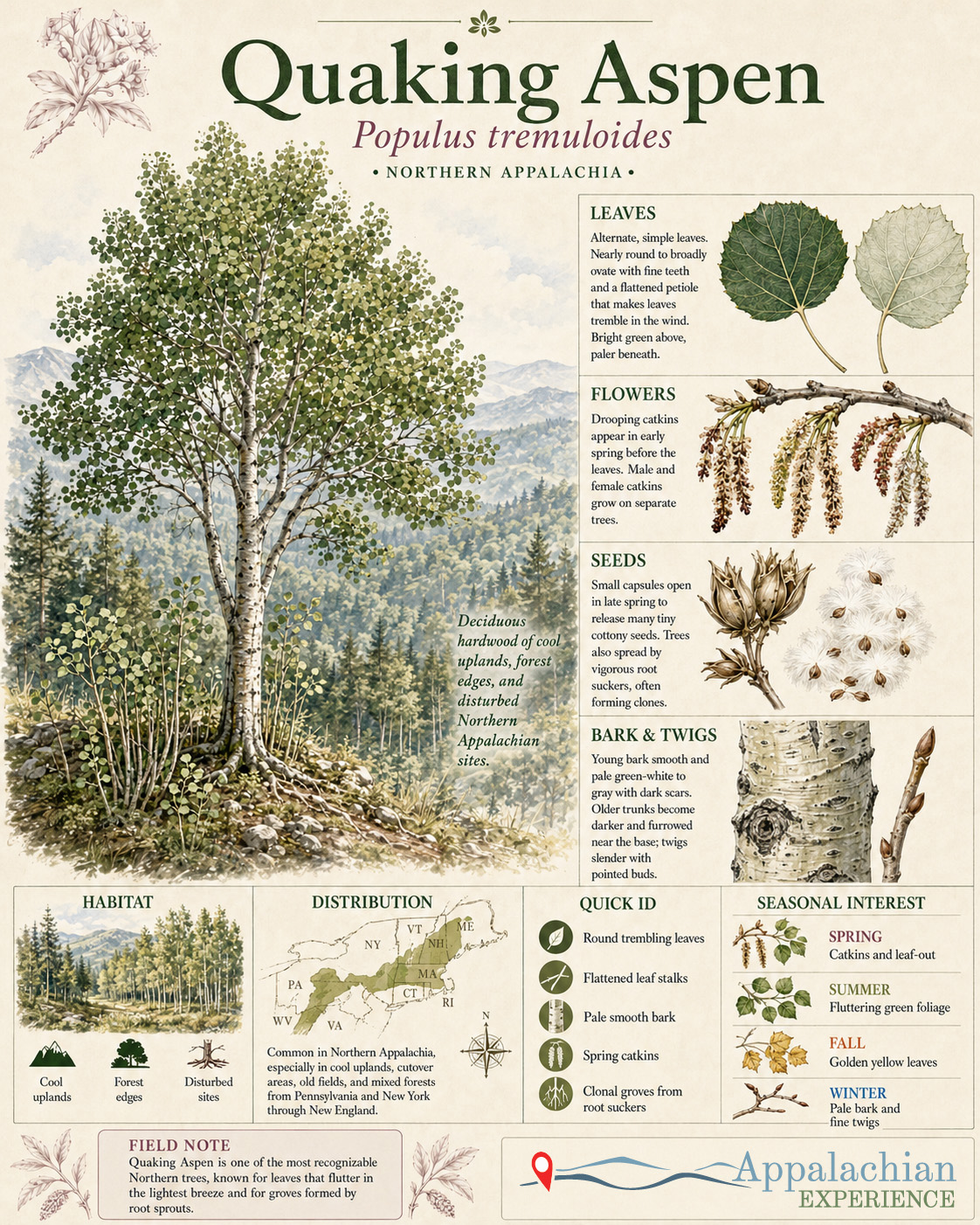
Quaking aspen is named for movement. Its flattened leaf stalks let the leaves tremble in light wind, so the tree seems to shimmer even on a still day. In Northern Appalachia, it is a tree of openings, disturbance, and cool northern edges.
Quick Facts
Common Name
Scientific Name
Family
Plant Type
Typical Size
Flowers / Pollen Cones
Fruit / Seed /Seed Cones
Common Habitat
Caution
Quaking Aspen
Populus tremuloides
Salicaceae, the willow family
Deciduous hardwood tree
Often 40 to 70 feet tall
Catkins in spring before leaf-out
Tiny seeds with cottony hairs
Disturbed sites, old fields, burns, cool slopes, and northern forests
No major public safety caution; weak wood can break in storms
Where it Grows
In Northern Appalachia, quaking aspen appears in disturbed sites, old fields, burns, edges, and cool forests. It is more common northward and at higher elevations.
How to Identify It
Look for smooth pale bark, rounded leaves with fine teeth, flattened leaf stalks, and trembling leaves. Aspen often grows in clonal groups, with many stems connected by root suckers.
Importance to the Appalchia Ecosystem
Quaking aspen is a pioneer tree that quickly occupies open ground. Its young shoots and bark feed wildlife, and its clonal growth creates dense early habitat.
More trees...
Northern Appalachia
Southern Appalachia
Human Uses
The wood is light and used for pulp, oriented strand board, matches, boxes, and light lumber. Its main field interest is ecological movement and clonal growth.
Interesting Facts
It is one of the widest-ranging native trees in North America.
Leaves tremble because the leaf stalks are flattened.
Many stems may be part of one clone.
Look-Alikes
Quaking aspen can be confused with bigtooth aspen and some poplars. Quaking aspen leaves are smaller and more rounded, with fine teeth.
Cautions and Common Problems
Aspen is short-lived and prone to decay, cankers, leaf diseases, and breakage. It needs light and declines under shade.
Seasonal Interest
Spring brings catkins. Summer leaves shimmer in wind. Fall color is yellow. Winter shows pale bark and clonal stems.
In the Appalachian Landscape
Quaking aspen adds motion to the northern Appalachian landscape. Even a small stand can make the edge of a field or slope feel alive with movement.
Sources and Further Reading
- U.S. Forest Service Silvics of North America, Quaking Aspen. https://research.fs.usda.gov/silvics/quaking-aspen
Last reviewed: 2026-10-07
Northern Appalachian Trees
Southern Appalachian Trees
Start your journey today at Appalachian Experience—where adventure meets tradition.
Get the Appalachian Experience Newsletter
Unlock the wonders of the Appalachian Mountains! Subscribe to our newsletter for the latest updates on attractions, events, and hidden gems. Follow us on social media to stay inspired by the beauty and adventure that awaits. Join our community today!